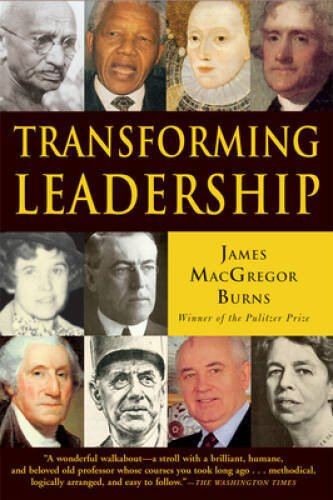
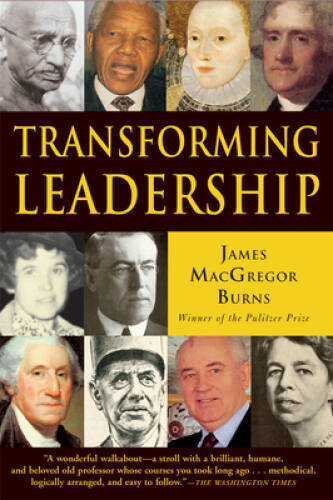
Transforming Leadership – Paperback By Burns, James MacGregor – ACCEPTABLE

$4.64

Item specifics

Condition
Acceptable: A book with obvious wear. May have some damage to the cover but integrity still intact. …

Brand
Unbranded
MPN
Does not apply
ISBN
9780802141187
Book Title
Transforming Leadership : the New Pursuit of Happiness
Publisher
GROVE/Atlantic, Incorporated
Item Length
8.2 in
Publication Year
2004
Format
Trade Paperback
Language
English
Item Height
0.9 in
Author
James Macgregor Burns
Genre
Political Science, Business & Economics, History
Topic
Leadership, Political Process / General, United States / General
Item Weight
14.5 Oz
Item Width
5.5 in
Number of Pages
336 Pages

Transforming Leadership – Paperback By Burns, James MacGregor – ACCEPTABLE

About this product

Product Identifiers

Publisher
GROVE/Atlantic, Incorporated
ISBN-10
0802141188
ISBN-13
9780802141187
eBay Product ID (ePID)
30240596

Product Key Features

Book Title
Transforming Leadership : the New Pursuit of Happiness
Number of Pages
336 Pages
Language
English
Publication Year
2004
Topic
Leadership, Political Process / General, United States / General
Genre
Political Science, Business & Economics, History
Author
James Macgregor Burns
Format
Trade Paperback

Dimensions

Item Height
0.9 in
Item Weight
14.5 Oz
Item Length
8.2 in
Item Width
5.5 in

Additional Product Features

Intended Audience
Trade
Synopsis
In Transforming Leadership, Burns illuminates the evolution of leadership structures, from the chieftains of tribal African societies, through Europe’s absolute monarchies, to the blossoming of the Enlightenment’s ideals of liberty and happiness during the American Revolution. Along the way he looks at key breakthroughs in leadership and the towering leaders who attempted to transform their worlds–Elizabeth I, Washington, Jefferson, Gandhi, Eleanor Roosevelt, Gorbachev, and others. Culminating in a bold and innovative plan to address the greatest global leadership challenge of the twenty-first century, the long-intractable problem of global poverty, Transforming Leadership will arouse discussion and controversy in classrooms and boardrooms throughout the country., In 1978, Pulitzer Prize and National Book Award-winning historian James MacGregor Burns published Leadership, a seminal book dealing with how leaders interact with society and through their efforts have the power to shape the course of history. The book became the basis for an emerging field of leadership studies that has been applied throughout the social sciences as well as in business and government. Now Burns has returned to the subject, offering a new vision of leadership-Transforming Leadership-that focuses on the ways that leaders emerge from being ordinary “transactional” brokers and deal-makers to become real agents of major social change who empower their followers. Through the course of the book, Burns illuminates the evolution of leadership structures, from the chieftains of tribal African societies, through Europe’s absolute monarchies, to the blossoming of the Enlightenment’s views of liberty that came to fruition in the American Revolution. Along the way he looks at key moments in leadership, and the great leaders who made them, including Cleopatra, Elizabeth I, James Madison, Napoleon, Mao, Gandhi, and Mikhail Gorbachev. Part One: Change Chapter 1: The Mysteries of Leadership An introduction to Burns’ concept of leadership-how leaders differ from tyrants, and transactional leaders from transforming leaders-and how this differs from other “Great Man” views of history. Chapter 2: Searching for the X-Factor Looking at his own studies of FDR and other leaders, Burns looks at how change emanates from society, and how this shapes community and society. Leadership is the “X-Factor” that brings change from concept to social reality. Part Two: Leaders Chapter 3: Kings and Queens, Knights and Pawns Using the game of chess as a metaphor for leadership action in monarchical society, Burns looks at the leadership systems of African tribes, and how monarchy evolved to the absolute model in post-Renaissance Europe, with a portrait of Elizabeth I’s successful leadership during a turbulent period in English history. Chapter 4: Leaders as Planners A look at transforming leadership outside the political arena, including the building of the Suez and Panama Canals and Charles Eliot and the making of Harvard University into a world-renown institution. Part Three: Leadership Chapter 5: The Transformation of American Leadership A look at the American Revolutionary Period, and how leaders like Jefferson, Hamilton, and Madison created the Declaration of Independence and the Constitution that first brought to political life the 18th century enlightenment ideals of “Life, Liberty, and the Pursuit of Happiness”-from the foundation of America’s political culture to the formation of America’s political parties. Chapter 6: France: Trials of Leadership How the French Revolution, begun in the spirit of “Libety, Equality, and Fraternity” spun out of control because of the leadership failures of men like Robespierre-and how it ultimately resulted in the military strongman Napoleon coming to power, with dire consequences for Europe. Chapter 7: Leadership as Conflict Burns argues that conflict is an essential component to getting beyond transactional leadership into transforming leadership-that ideals and ideas must clash to yield continuing and meaningful social change. He looks through the historical prism of the 19th century Tory Party’s “Loyal Opposition” in Britain (to view its success) and Gorbachev’s Perestroika and Glasnost initiatives of the 1980s (and why they failed). Part Four: People Chapter 8: The Anatomy of Motivation A look at the human causes behind the necessity for social change, what the great thinkers have had to say about it from Rousseau to Marx, and how wants become needs that create demands for change. Chapter 9: Creative Leadership From da Vinci to Einstein, the genius intellect has been able to transform our understanding of the world through his or her creative visio

Description


Item specifics

Condition
Acceptable: A book with obvious wear. May have some damage to the cover but integrity still intact. …

Brand
Unbranded
MPN
Does not apply
ISBN
9780802141187
Book Title
Transforming Leadership : the New Pursuit of Happiness
Publisher
GROVE/Atlantic, Incorporated
Item Length
8.2 in
Publication Year
2004
Format
Trade Paperback
Language
English
Item Height
0.9 in
Author
James Macgregor Burns
Genre
Political Science, Business & Economics, History
Topic
Leadership, Political Process / General, United States / General
Item Weight
14.5 Oz
Item Width
5.5 in
Number of Pages
336 Pages

Transforming Leadership – Paperback By Burns, James MacGregor – ACCEPTABLE

About this product

Product Identifiers

Publisher
GROVE/Atlantic, Incorporated
ISBN-10
0802141188
ISBN-13
9780802141187
eBay Product ID (ePID)
30240596

Product Key Features

Book Title
Transforming Leadership : the New Pursuit of Happiness
Number of Pages
336 Pages
Language
English
Publication Year
2004
Topic
Leadership, Political Process / General, United States / General
Genre
Political Science, Business & Economics, History
Author
James Macgregor Burns
Format
Trade Paperback

Dimensions

Item Height
0.9 in
Item Weight
14.5 Oz
Item Length
8.2 in
Item Width
5.5 in

Additional Product Features

Intended Audience
Trade
Synopsis
In Transforming Leadership, Burns illuminates the evolution of leadership structures, from the chieftains of tribal African societies, through Europe’s absolute monarchies, to the blossoming of the Enlightenment’s ideals of liberty and happiness during the American Revolution. Along the way he looks at key breakthroughs in leadership and the towering leaders who attempted to transform their worlds–Elizabeth I, Washington, Jefferson, Gandhi, Eleanor Roosevelt, Gorbachev, and others. Culminating in a bold and innovative plan to address the greatest global leadership challenge of the twenty-first century, the long-intractable problem of global poverty, Transforming Leadership will arouse discussion and controversy in classrooms and boardrooms throughout the country., In 1978, Pulitzer Prize and National Book Award-winning historian James MacGregor Burns published Leadership, a seminal book dealing with how leaders interact with society and through their efforts have the power to shape the course of history. The book became the basis for an emerging field of leadership studies that has been applied throughout the social sciences as well as in business and government. Now Burns has returned to the subject, offering a new vision of leadership-Transforming Leadership-that focuses on the ways that leaders emerge from being ordinary “transactional” brokers and deal-makers to become real agents of major social change who empower their followers. Through the course of the book, Burns illuminates the evolution of leadership structures, from the chieftains of tribal African societies, through Europe’s absolute monarchies, to the blossoming of the Enlightenment’s views of liberty that came to fruition in the American Revolution. Along the way he looks at key moments in leadership, and the great leaders who made them, including Cleopatra, Elizabeth I, James Madison, Napoleon, Mao, Gandhi, and Mikhail Gorbachev. Part One: Change Chapter 1: The Mysteries of Leadership An introduction to Burns’ concept of leadership-how leaders differ from tyrants, and transactional leaders from transforming leaders-and how this differs from other “Great Man” views of history. Chapter 2: Searching for the X-Factor Looking at his own studies of FDR and other leaders, Burns looks at how change emanates from society, and how this shapes community and society. Leadership is the “X-Factor” that brings change from concept to social reality. Part Two: Leaders Chapter 3: Kings and Queens, Knights and Pawns Using the game of chess as a metaphor for leadership action in monarchical society, Burns looks at the leadership systems of African tribes, and how monarchy evolved to the absolute model in post-Renaissance Europe, with a portrait of Elizabeth I’s successful leadership during a turbulent period in English history. Chapter 4: Leaders as Planners A look at transforming leadership outside the political arena, including the building of the Suez and Panama Canals and Charles Eliot and the making of Harvard University into a world-renown institution. Part Three: Leadership Chapter 5: The Transformation of American Leadership A look at the American Revolutionary Period, and how leaders like Jefferson, Hamilton, and Madison created the Declaration of Independence and the Constitution that first brought to political life the 18th century enlightenment ideals of “Life, Liberty, and the Pursuit of Happiness”-from the foundation of America’s political culture to the formation of America’s political parties. Chapter 6: France: Trials of Leadership How the French Revolution, begun in the spirit of “Libety, Equality, and Fraternity” spun out of control because of the leadership failures of men like Robespierre-and how it ultimately resulted in the military strongman Napoleon coming to power, with dire consequences for Europe. Chapter 7: Leadership as Conflict Burns argues that conflict is an essential component to getting beyond transactional leadership into transforming leadership-that ideals and ideas must clash to yield continuing and meaningful social change. He looks through the historical prism of the 19th century Tory Party’s “Loyal Opposition” in Britain (to view its success) and Gorbachev’s Perestroika and Glasnost initiatives of the 1980s (and why they failed). Part Four: People Chapter 8: The Anatomy of Motivation A look at the human causes behind the necessity for social change, what the great thinkers have had to say about it from Rousseau to Marx, and how wants become needs that create demands for change. Chapter 9: Creative Leadership From da Vinci to Einstein, the genius intellect has been able to transform our understanding of the world through his or her creative visio

Price : 4.64

Ends on : N/A

View on eBay

We use cookies to ensure that we give you the best experience on our website.