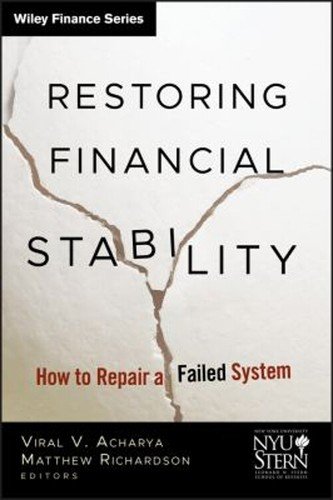
Restoring Financial Stability : How to Repair a Failed System Har

$6.97

Item specifics

Condition
Very Good

A book that does not look new and has been read but is in excellent condition. No obvious damage to the cover, with the dust jacket (if applicable) included for hard covers. No missing or damaged pages, no creases or tears, and no underlining/highlighting of text or writing in the margins. May be very minimal identifying marks on the inside cover. Very minimal wear and tear. See the seller’s listing for full details and description of any imperfections. See all condition definitionsopens in a new window or tab

Seller Notes
“Used book that is in excellent condition. May show signs of wear or have minor defects. 100% …

Publication Name
Wiley & Sons, Incorporated, John
ISBN
9780470499344
Book Title
Restoring Financial Stability : How to Repair a Failed System
Book Series
Wiley Finance Ser.
Publisher
Wiley & Sons, Incorporated, John
Item Length
9.4 in
Publication Year
2009
Format
Hardcover
Language
English
Illustrator
Yes
Item Height
1.4 in
Author
New York University Stern School of Business
Genre
Business & Economics
Topic
Banks & Banking, Economic History, Finance / General, Economic Conditions, Industries / Financial Services
Item Weight
22.3 Oz
Item Width
6.3 in
Number of Pages
416 Pages

Restoring Financial Stability : How to Repair a Failed System Har

About this product

Product Identifiers

Publisher
Wiley & Sons, Incorporated, John
ISBN-10
0470499346
ISBN-13
9780470499344
eBay Product ID (ePID)
71862540

Product Key Features

Book Title
Restoring Financial Stability : How to Repair a Failed System
Number of Pages
416 Pages
Language
English
Publication Year
2009
Topic
Banks & Banking, Economic History, Finance / General, Economic Conditions, Industries / Financial Services
Illustrator
Yes
Genre
Business & Economics
Author
New York University Stern School of Business
Book Series
Wiley Finance Ser.
Format
Hardcover

Dimensions

Item Height
1.4 in
Item Weight
22.3 Oz
Item Length
9.4 in
Item Width
6.3 in

Additional Product Features

Intended Audience
Trade
LCCN
2009-004115
Dewey Edition
22
Reviews
“In conclusion, this book should be read by every serious observer of the crisis. It is an outstanding contribution.” ( Lombard Street ) “…ably tackles complex issues and covers a wide spectrum of the current debate, including the multiplicity of regulators, the need for international regulatory coordination, transparency, fair value accounting, compensation reform, and the extent to which monetary policy should address systemic asset bubbles.” ( The Investment Professional ) “…the book that best combines history, analysis and prescription is “Restoring Financial Stability”, a series of essays by academics at New York University’s Stern School of Business. The 60-page prologue is packed with telling facts and sophisticated analysis, and alone is worth the steep cover price. The individual chapters deal methodically with the myriad issues raised by the crunch, and the policy changes that will be needed, covering everything from the American mortgage market to the need for international cooperation in regulating finance.” ( The Economist ) “We are always better analysts with a 20/20 hindsight. Indeed, an ex post reading about events leading up to a crisis appears logical, and often leaves one with the question about why the evolution of the crisis could not be seen and corrected in time. Still, policy-makers know that such a review and understanding are important to learning from mistakes. Restoring Financial Stability (Wiley) acts as a catalyst to that understanding by offering a comprehensive sequencing of the causes and progression of the build-up of the financial strains that . . evolved into a full-blown global financial crisis. . . highly recommended even though bankers will remain bankers and will probably figure out ways to beat the new system.” (Business Standard)
Series Volume Number
542
Dewey Decimal
339.50973
Table Of Content
Foreword xi Acknowledgments xiii Prologue: A Bird’s-Eye View The Financial Crisis of 2007-2009: Causes and Remedies 1 Viral V. Acharya, Thomas Philippon, Matthew Richardson, and Nouriel Roubini Part One Causes of the Financial Crisis of 2007-2009 57 Matthew Richardson Chapter 1 Mortgage Origination and Securitization in the Financial Crisis 61 Dwight Jaffee, Anthony W. Lynch, Matthew Richardson, and Stijn Van Nieuwerburgh Chapter 2 How Banks Played the Leverage Game 83 Viral V. Acharya and Philipp Schnabl Chapter 3 The Rating Agencies: Is Regulation the Answer? 101 Matthew Richardson and Lawrence J. White Part Two Financial Institutions 117 Matthew Richardson Chapter 4 What to Do about the Government-Sponsored Enterprises? 121 Dwight Jaffee, Matthew Richardson, Stijn Van Nieuwerburgh, Lawrence J. White, and Robert E. Wright Chapter 5 Enhanced Regulation of Large, Complex Financial Institutions 139 Anthony Saunders, Roy C. Smith, and Ingo Walter Chapter 6 Hedge Funds in the Aftermath of the Financial Crisis 157 Stephen J. Brown, Marcin Kacperczyk, Alexander Ljungqvist, Anthony W. Lynch, Lasse H. Pedersen, and Matthew Richardson Part Three Governance, Incentives, and Fair Value Accounting Overview 179 Viral V. Acharya and Rangarajan K. Sundaram Chapter 7 Corporate Governance in the Modern Financial Sector 185 Viral V. Acharya, Jennifer N. Carpenter, Xavier Gabaix, Kose John, Matthew Richardson, Marti G. Subrahmanyam, Rangarajan K. Sundaram, and Eitan Zemel Chapter 8 Rethinking Compensation in Financial Firms 197 Gian Luca Clementi, Thomas F. Cooley, Matthew Richardson, and Ingo Walter Chapter 9 Fair Value Accounting: Policy Issues Raised by the Credit Crunch 215 Stephen G. Ryan Part Four Derivatives, Short Selling, and Transparency 229 Viral V. Acharya Chapter 10 Derivatives: The Ultimate Financial Innovation 233 Viral V. Acharya, Menachem Brenner, Robert F. Engle, Anthony W. Lynch, and Matthew Richardson Chapter 11 Centralized Clearing for Credit Derivatives 251 Viral V. Acharya, Robert F. Engle, Stephen Figlewski, Anthony W. Lynch, and Marti G. Subrahmanyam Chapter 12 Short Selling 269 Menachem Brenner and Marti G. Subrahmanyam Part Five The Role of the Federal Reserve 277 Thomas F. Cooley and Thomas Philippon Chapter 13 Regulating Systemic Risk 283 Viral V. Acharya, Lasse H. Pedersen, Thomas Philippon, and Matthew Richardson Chapter 14 Private Lessons for Public Banking: The Case for Conditionality in LOLR Facilities 305 Viral V. Acharya and David K. Backus Part Six The Bailout 323 Thomas F. Cooley and Thomas Philippon Chapter 15 The Financial Sector Bailout: Sowing the Seeds of the Next Crisis? 327 Viral V. Acharya and Rangarajan K. Sundaram Chapter 16 Mortgages and Households 341 Andrew Caplin and Thomas F. Cooley Chapter 17 Where Should the Bailout Stop? 353 Edward I. Altman and Thomas Philippon Part Seven International Coordination 363 Chapter 18 International Alignment of Financial Sector Regulation 365 Viral V. Acharya, Paul Wachtel, and Ingo Walter About the Authors 377 Index 381
Synopsis
An insightful look at how to reform our broken financial system The financial crisis that unfolded in September 2008 transformed the United States and world economies., Praise for Restoring Financial Stability “The Stern School faculty is making an important contribution to the needed debate about how to go about reforming our broken financial system. Plainly, the insights of financial theory need to be better adapted to the practical requirements of maintaining reasonable stability of markets and institutions. Restoring Financial Stability: How to Repair a Failed System helps point the way.” Paul Volcker , Chairman of Economic Recovery Advisory Board and former Chairman of the Federal Reserve (1979 1987) “Although we are yet in the midst of a gigantic global financial crisis, the academics who contributed to this timely and comprehensive compendium have provided us with not only an excellent analysis on each topic, but also timely recommendations as to how to move forward responsibly to develop the next generation of our financial-service industry architecture.” Myron Scholes , Chairman of Platinum Grove Asset Management and winner of the 1997 Nobel Prize in Economics “The authors provide important perspectives on both the causes of the global financial crisis as well as proposed solutions to ensure it doesnt happen again. A must-read for anyone interested or involved in the financial markets.” John Paulson , President and founder of Paulson & Co, Inc. “No sustainable economic recovery can take hold until our tattered financial system is not just repaired but, more importantly, until its institutional framework is restructured and new rules of financial behavior are put in place. This book, the work of prominent academicians from a leading school of business, makes an important contribution to the framing of the problems and provides specific recommendations for their solutions. What makes this book especially valuable is its detailed evaluations and analyses covering many spectrums of the marketplace.” Henry Kaufman , President of Henry Kaufman & Co., Inc. “This book consists of a set of papers providing a comprehensive and incisive analysis of perhaps the greatest crisis to hit the capitalist system in recent times. The papers are by renowned experts in the area. Together, they constitute an indispensable read for anyone interested in understanding the roots of the crisis and trying to formulate policies to resolve it.” Raghuram G. Rajan , Eric J. Gleacher Distinguished Service Professor of Finance, Chicago Booth School of Business, and former Chief Economist at the International Monetary Fund (2003 2006), An insightful look at how to reform our broken financial system The financial crisis that unfolded in September 2008 transformed the United States and world economies. As each day’s headlines brought stories of bank failures and rescues, government policies drawn and redrawn against the backdrop of an historic Presidential election, and solutions that seemed to be discarded almost as soon as they were proposed, a group of thirty-three academics at New York University Stern School of Business began tackling the hard questions behind the headlines. Representing fields of finance, economics, and accounting, these professors-led by Dean Thomas Cooley and Vice Dean Ingo Walter-shaped eighteen independent policy papers that proposed market-focused solutions to the problems within a common framework. In December, with great urgency, they sent hand-bound copies to Washington. Restoring Financial Stability is the culmination of their work. Proposes bold, yet principled approaches-including financial policy alternatives and specific courses of action-to deal with this unprecedented, systemic financial crisis Created by the contributions of various academics from New York University’s Stern School of Business Provides important perspectives on both the causes of the global financial crisis as well as proposed solutions to ensure it doesn’t happen again Contains detailed evaluations and analyses covering many spectrums of the marketplace Edited by Matthew Richardson and Viral Acharya, this reliable resource brings together the best thinking of finance and economics from the faculty of one of the top universities in world.
LC Classification Number
HG181.R37 2009

Description


Item specifics

Condition
Very Good

A book that does not look new and has been read but is in excellent condition. No obvious damage to the cover, with the dust jacket (if applicable) included for hard covers. No missing or damaged pages, no creases or tears, and no underlining/highlighting of text or writing in the margins. May be very minimal identifying marks on the inside cover. Very minimal wear and tear. See the seller’s listing for full details and description of any imperfections. See all condition definitionsopens in a new window or tab

Seller Notes
“Used book that is in excellent condition. May show signs of wear or have minor defects. 100% …

Publication Name
Wiley & Sons, Incorporated, John
ISBN
9780470499344
Book Title
Restoring Financial Stability : How to Repair a Failed System
Book Series
Wiley Finance Ser.
Publisher
Wiley & Sons, Incorporated, John
Item Length
9.4 in
Publication Year
2009
Format
Hardcover
Language
English
Illustrator
Yes
Item Height
1.4 in
Author
New York University Stern School of Business
Genre
Business & Economics
Topic
Banks & Banking, Economic History, Finance / General, Economic Conditions, Industries / Financial Services
Item Weight
22.3 Oz
Item Width
6.3 in
Number of Pages
416 Pages

Restoring Financial Stability : How to Repair a Failed System Har

About this product

Product Identifiers

Publisher
Wiley & Sons, Incorporated, John
ISBN-10
0470499346
ISBN-13
9780470499344
eBay Product ID (ePID)
71862540

Product Key Features

Book Title
Restoring Financial Stability : How to Repair a Failed System
Number of Pages
416 Pages
Language
English
Publication Year
2009
Topic
Banks & Banking, Economic History, Finance / General, Economic Conditions, Industries / Financial Services
Illustrator
Yes
Genre
Business & Economics
Author
New York University Stern School of Business
Book Series
Wiley Finance Ser.
Format
Hardcover

Dimensions

Item Height
1.4 in
Item Weight
22.3 Oz
Item Length
9.4 in
Item Width
6.3 in

Additional Product Features

Intended Audience
Trade
LCCN
2009-004115
Dewey Edition
22
Reviews
“In conclusion, this book should be read by every serious observer of the crisis. It is an outstanding contribution.” ( Lombard Street ) “…ably tackles complex issues and covers a wide spectrum of the current debate, including the multiplicity of regulators, the need for international regulatory coordination, transparency, fair value accounting, compensation reform, and the extent to which monetary policy should address systemic asset bubbles.” ( The Investment Professional ) “…the book that best combines history, analysis and prescription is “Restoring Financial Stability”, a series of essays by academics at New York University’s Stern School of Business. The 60-page prologue is packed with telling facts and sophisticated analysis, and alone is worth the steep cover price. The individual chapters deal methodically with the myriad issues raised by the crunch, and the policy changes that will be needed, covering everything from the American mortgage market to the need for international cooperation in regulating finance.” ( The Economist ) “We are always better analysts with a 20/20 hindsight. Indeed, an ex post reading about events leading up to a crisis appears logical, and often leaves one with the question about why the evolution of the crisis could not be seen and corrected in time. Still, policy-makers know that such a review and understanding are important to learning from mistakes. Restoring Financial Stability (Wiley) acts as a catalyst to that understanding by offering a comprehensive sequencing of the causes and progression of the build-up of the financial strains that . . evolved into a full-blown global financial crisis. . . highly recommended even though bankers will remain bankers and will probably figure out ways to beat the new system.” (Business Standard)
Series Volume Number
542
Dewey Decimal
339.50973
Table Of Content
Foreword xi Acknowledgments xiii Prologue: A Bird’s-Eye View The Financial Crisis of 2007-2009: Causes and Remedies 1 Viral V. Acharya, Thomas Philippon, Matthew Richardson, and Nouriel Roubini Part One Causes of the Financial Crisis of 2007-2009 57 Matthew Richardson Chapter 1 Mortgage Origination and Securitization in the Financial Crisis 61 Dwight Jaffee, Anthony W. Lynch, Matthew Richardson, and Stijn Van Nieuwerburgh Chapter 2 How Banks Played the Leverage Game 83 Viral V. Acharya and Philipp Schnabl Chapter 3 The Rating Agencies: Is Regulation the Answer? 101 Matthew Richardson and Lawrence J. White Part Two Financial Institutions 117 Matthew Richardson Chapter 4 What to Do about the Government-Sponsored Enterprises? 121 Dwight Jaffee, Matthew Richardson, Stijn Van Nieuwerburgh, Lawrence J. White, and Robert E. Wright Chapter 5 Enhanced Regulation of Large, Complex Financial Institutions 139 Anthony Saunders, Roy C. Smith, and Ingo Walter Chapter 6 Hedge Funds in the Aftermath of the Financial Crisis 157 Stephen J. Brown, Marcin Kacperczyk, Alexander Ljungqvist, Anthony W. Lynch, Lasse H. Pedersen, and Matthew Richardson Part Three Governance, Incentives, and Fair Value Accounting Overview 179 Viral V. Acharya and Rangarajan K. Sundaram Chapter 7 Corporate Governance in the Modern Financial Sector 185 Viral V. Acharya, Jennifer N. Carpenter, Xavier Gabaix, Kose John, Matthew Richardson, Marti G. Subrahmanyam, Rangarajan K. Sundaram, and Eitan Zemel Chapter 8 Rethinking Compensation in Financial Firms 197 Gian Luca Clementi, Thomas F. Cooley, Matthew Richardson, and Ingo Walter Chapter 9 Fair Value Accounting: Policy Issues Raised by the Credit Crunch 215 Stephen G. Ryan Part Four Derivatives, Short Selling, and Transparency 229 Viral V. Acharya Chapter 10 Derivatives: The Ultimate Financial Innovation 233 Viral V. Acharya, Menachem Brenner, Robert F. Engle, Anthony W. Lynch, and Matthew Richardson Chapter 11 Centralized Clearing for Credit Derivatives 251 Viral V. Acharya, Robert F. Engle, Stephen Figlewski, Anthony W. Lynch, and Marti G. Subrahmanyam Chapter 12 Short Selling 269 Menachem Brenner and Marti G. Subrahmanyam Part Five The Role of the Federal Reserve 277 Thomas F. Cooley and Thomas Philippon Chapter 13 Regulating Systemic Risk 283 Viral V. Acharya, Lasse H. Pedersen, Thomas Philippon, and Matthew Richardson Chapter 14 Private Lessons for Public Banking: The Case for Conditionality in LOLR Facilities 305 Viral V. Acharya and David K. Backus Part Six The Bailout 323 Thomas F. Cooley and Thomas Philippon Chapter 15 The Financial Sector Bailout: Sowing the Seeds of the Next Crisis? 327 Viral V. Acharya and Rangarajan K. Sundaram Chapter 16 Mortgages and Households 341 Andrew Caplin and Thomas F. Cooley Chapter 17 Where Should the Bailout Stop? 353 Edward I. Altman and Thomas Philippon Part Seven International Coordination 363 Chapter 18 International Alignment of Financial Sector Regulation 365 Viral V. Acharya, Paul Wachtel, and Ingo Walter About the Authors 377 Index 381
Synopsis
An insightful look at how to reform our broken financial system The financial crisis that unfolded in September 2008 transformed the United States and world economies., Praise for Restoring Financial Stability “The Stern School faculty is making an important contribution to the needed debate about how to go about reforming our broken financial system. Plainly, the insights of financial theory need to be better adapted to the practical requirements of maintaining reasonable stability of markets and institutions. Restoring Financial Stability: How to Repair a Failed System helps point the way.” Paul Volcker , Chairman of Economic Recovery Advisory Board and former Chairman of the Federal Reserve (1979 1987) “Although we are yet in the midst of a gigantic global financial crisis, the academics who contributed to this timely and comprehensive compendium have provided us with not only an excellent analysis on each topic, but also timely recommendations as to how to move forward responsibly to develop the next generation of our financial-service industry architecture.” Myron Scholes , Chairman of Platinum Grove Asset Management and winner of the 1997 Nobel Prize in Economics “The authors provide important perspectives on both the causes of the global financial crisis as well as proposed solutions to ensure it doesnt happen again. A must-read for anyone interested or involved in the financial markets.” John Paulson , President and founder of Paulson & Co, Inc. “No sustainable economic recovery can take hold until our tattered financial system is not just repaired but, more importantly, until its institutional framework is restructured and new rules of financial behavior are put in place. This book, the work of prominent academicians from a leading school of business, makes an important contribution to the framing of the problems and provides specific recommendations for their solutions. What makes this book especially valuable is its detailed evaluations and analyses covering many spectrums of the marketplace.” Henry Kaufman , President of Henry Kaufman & Co., Inc. “This book consists of a set of papers providing a comprehensive and incisive analysis of perhaps the greatest crisis to hit the capitalist system in recent times. The papers are by renowned experts in the area. Together, they constitute an indispensable read for anyone interested in understanding the roots of the crisis and trying to formulate policies to resolve it.” Raghuram G. Rajan , Eric J. Gleacher Distinguished Service Professor of Finance, Chicago Booth School of Business, and former Chief Economist at the International Monetary Fund (2003 2006), An insightful look at how to reform our broken financial system The financial crisis that unfolded in September 2008 transformed the United States and world economies. As each day’s headlines brought stories of bank failures and rescues, government policies drawn and redrawn against the backdrop of an historic Presidential election, and solutions that seemed to be discarded almost as soon as they were proposed, a group of thirty-three academics at New York University Stern School of Business began tackling the hard questions behind the headlines. Representing fields of finance, economics, and accounting, these professors-led by Dean Thomas Cooley and Vice Dean Ingo Walter-shaped eighteen independent policy papers that proposed market-focused solutions to the problems within a common framework. In December, with great urgency, they sent hand-bound copies to Washington. Restoring Financial Stability is the culmination of their work. Proposes bold, yet principled approaches-including financial policy alternatives and specific courses of action-to deal with this unprecedented, systemic financial crisis Created by the contributions of various academics from New York University’s Stern School of Business Provides important perspectives on both the causes of the global financial crisis as well as proposed solutions to ensure it doesn’t happen again Contains detailed evaluations and analyses covering many spectrums of the marketplace Edited by Matthew Richardson and Viral Acharya, this reliable resource brings together the best thinking of finance and economics from the faculty of one of the top universities in world.
LC Classification Number
HG181.R37 2009

Price : 6.97

Ends on : N/A

View on eBay

We use cookies to ensure that we give you the best experience on our website.