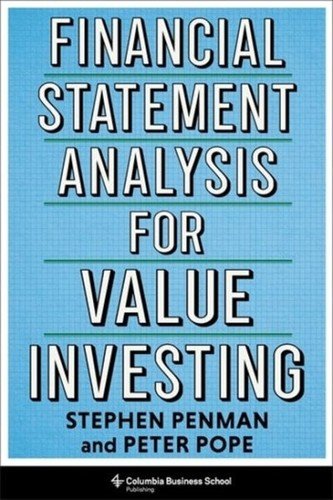
Description
Item specifics
-
Condition
-
-
ISBN
-
9780231215688
-
Book Title
-
Financial Statement Analysis for Value Investing
-
Book Series
-
Heilbrunn Center for Graham and Dodd Investing Ser.
-
Publisher
-
Columbia University Press
-
Item Length
-
0.9 in
-
Publication Year
-
2025
-
Format
-
Hardcover
-
Language
-
English
-
Illustrator
-
Yes
-
Item Height
-
0.1 in
-
Genre
-
Business & Economics
-
Topic
-
Accounting / Financial, Accounting / General, Finance / General, Investments & Securities / General
-
Item Weight
-
29.9 Oz
-
Item Width
-
0.6 in
-
Number of Pages
-
432 Pages
Financial Statement Analysis for Value Investing, Hardcover by Penman, Stephe…
About this product
Product Identifiers
Publisher
Columbia University Press
ISBN-10
0231215681
ISBN-13
9780231215688
eBay Product ID (ePID)
17068798773
Product Key Features
Book Title
Financial Statement Analysis for Value Investing
Number of Pages
432 Pages
Language
English
Topic
Accounting / Financial, Accounting / General, Finance / General, Investments & Securities / General
Publication Year
2025
Illustrator
Yes
Genre
Business & Economics
Book Series
Heilbrunn Center for Graham and Dodd Investing Ser.
Format
Hardcover
Dimensions
Item Height
0.1 in
Item Weight
29.9 Oz
Item Length
0.9 in
Item Width
0.6 in
Additional Product Features
LCCN
2024-040250
Dewey Edition
23
Reviews
Stephen Penman’s Accounting for Value is a life-changing book for fundamental investors like myself who have made his framework the cornerstone of our investment approach. Joined by Peter F. Pope, Penman here provides an expanded and refined version of his principles, enriched with compelling real-world examples–an offering that could not be more timely amid the feverish exuberance of today’s stock markets. This is more than a book; it is destined to become the Holy Grail for generations of intelligent investors to come., While in danger of oversimplifying both books, Penman and Pope’s latest reads like a very modern, up to date, and rigorous version of Graham’s The Intelligent Investor. It is targeted at active value investors, yet this quant factor investor found it incredibly useful nonetheless (I will immediately try to suck the life out of these lessons by making a thousand tiny diversified bets based on them!). Highly recommended., Fundamental, active value investing has come under significant pressure in recent years. Against this backdrop, the work of Penman and Pope is very timely and refreshing. They strongly lay out the case for fundamental analysis as the basis for the rational valuation of a business. With many investors seemingly giving up on a value-based approach this work is hugely important in reminding investors about what value investing means and how to go about it. In an environment that has seen large changes in investors’ assumptions about foundational investment concepts, they offer a path to value investing that is not anchored on notions such as the cost of capital and instead use a critical accounting lens. Seen in this way, value investing is not stuck with simple valuation metrics or a debate about value vs growth and instead is focused on not overpaying for growth. This is one of the central investment questions today. Their rigorous approach is set out with numerous examples applied to individual companies that makes it very tangible to the user. There is also a larger narrative here that reminds us that fundamental value investing has an essential role as a mechanism for the allocation of capital., While in danger of oversimplifying both books, Penman and Pope’s latest reads like a very modern, up-to-date, and rigorous version of Graham’s The Intelligent Investor. It is targeted at active value investors, yet this quant factor investor found it incredibly useful nonetheless. (I will immediately try to suck the life out of these lessons by making a thousand tiny diversified bets based on them!) Highly recommended., This is a beautifully written book that shows how fundamental investment analysis should be done that fully exploits the information available in corporate financial statements and uses that as a platform to search out other information relevant to assessing a company’s future prospects. It is packed with explorations of real-life examples and shows how the investor can determine whether the stock market price is too high for the risks involved. A gem for graduate students and practitioners alike., Value investing has been around for almost a century – but how can investors modernize this popular investment style to generate active returns? Peter Pope and Stephen Penman’s book is a must read for anyone who is passionate about investing, and reveals how value investors can retain an edge over other investors in the times of emerging megatrends such as AI and ESG., Stephen Penman’s Accounting for Value is a life-changing book for fundamental investors like myself who have made his framework the cornerstone of our investment approach. Joined by Peter Pope, Penman here provides an expanded and refined version of his principles, enriched with compelling real-world examples–an offering that could not be more timely amid the feverish exuberance of today’s stock markets. This is more than a book; it is destined to become the Holy Grail for generations of intelligent investors to come., Financial Statement Analysis for Value Investing reads like a great suspense novel, with each chapter slowly revealing the answers to many questions you may have had about value investing but were too afraid to ask: Is free cash flow the right measure of value? And what about great companies like Amazon or Walmart that had no free cash flows for years? How can I invest confidently in those? Is forecasting years into the future to determine intrinsic value not highly speculative? And what discount rate do I use? With this book, the authors have provided a valuable practitioners guide that can serve as a solid foundation for value investors., Both Stephen Penman and Peter Pope are experts in the field of accounting, and with this book they offer a novel approach to integrate analysis of fundamentals into a systematic approach to value investing. They provide insights about why and when style investing works, especially classic style factors like value, growth, quality, profitability and investment., Penman and Pope combine academic chops with Wall Street savvy in this exciting new resource for value investors. Written in the style of an active investor, this book teaches financial statement analysis principles within a value investing framework. The structured “accounting books” approach combines quantitative rigor with practical applicability. Large sample findings and real-world cases further illustrate key concepts in action. A foundational reference suitable for both investment professionals and students new to value investing., Both Stephen Penman and Peter F. Pope are experts in the field of accounting, and with this book they offer a novel approach to integrate analysis of fundamentals into a systematic approach to value investing. They provide insights about why and when style investing works, especially classic style factors like value, growth, quality, profitability and investment., Value investing has been around for almost a century–but how can investors modernize this popular investment style to generate active returns? Penman and Pope’s book is a must-read for anyone who is passionate about investing, and reveals how value investors can retain an edge over other investors in the times of emerging megatrends such as AI and ESG.
Dewey Decimal
657.3
Table Of Content
Preface 1. Opening the Book 2. Cheap Value Investing 3. Keeping a Book for Value Investing 4. Accounting for the Market Price 5. Accounting for Leverage 6. Accounting for Profitability 7. Accounting for Growth 8. Accounting for Risk to Value 9. Keeping the Book: The Anchoring Balance Sheet 10. Keeping the Book: The Anchoring Income Statement 11. Investing by the Book: Special Situations 12. Investing by the Book: Investing in Style 13. Keeping a Book on Liquidity and the Analysis of Credit Risk 14. Closing the Book Index
Synopsis
How should an investor challenge the market price and find value? This book provides a new lens, arguing that value investing is a matter of understanding the business through accounting. Stephen Penman and Peter F. Pope-leading authorities on accounting and its investment applications-demonstrate why attention to financial statements is the key to judicious valuation. More broadly, they show that accounting fundamentals, when analyzed in a systematic manner, teach us how to think about value in new ways. This guide to investing through analysis of financial statements presents both underlying principles and practical examples. It examines how an accounting book is structured, the ways to read one in order to extract information about value, and why accounting techniques help investors avoid common traps. Through cases that depict finance, investing, and accounting principles in action, readers learn crucial lessons for challenging the market’s pricing. Financial Statement Analysis for Value Investing is essential reading for anyone interested in the fundamentals of value investing, practitioners and students alike. Both professional and individual investors can benefit from its techniques and insights, and it is well suited for value investing and financial statement analysis courses in business schools., How should an investor challenge the market price and find value? This book provides a new lens, arguing that value investing is a matter of understanding the business through accounting., How should an investor challenge the market price and find value? This book provides a new lens, arguing that value investing is a matter of understanding the business through accounting. Stephen Penman and Peter F. Pope–leading authorities on accounting and its investment applications–demonstrate why attention to financial statements is the key to judicious valuation. More broadly, they show that accounting fundamentals, when analyzed in a systematic manner, teach us how to think about value in new ways. This guide to investing through analysis of financial statements presents both underlying principles and practical examples. It examines how an accounting book is structured, the ways to read one in order to extract information about value, and why accounting techniques help investors avoid common traps. Through cases that depict finance, investing, and accounting principles in action, readers learn crucial lessons for challenging the market’s pricing. Financial Statement Analysis for Value Investing is essential reading for anyone interested in the fundamentals of value investing, practitioners and students alike. Both professional and individual investors can benefit from its techniques and insights, and it is well suited for value investing and financial statement analysis courses in business schools.
LC Classification Number
HG4028.B2P46 2025
Price : 52.90 – 50.32
Ends on : N/A
View on eBay


