
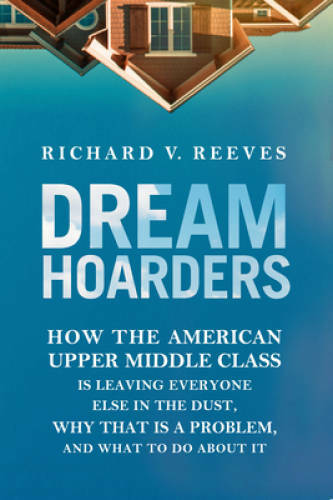
Dream Hoarders: How the American Upper Middle Class Is Leaving Everyone E – GOOD

$4.98

Item specifics

Condition
Good: A book that has been read but is in good condition. Very minimal damage to the cover including …

Brand
Unbranded
MPN
Does not apply
ISBN
9780815729129
Book Title
Dream Hoarders : How the American Upper Middle Class Is Leaving Everyone Else in the Dust, Why That Is a Problem, and What to Do about It
Publisher
Brookings Institution Press
Item Length
1 in
Publication Year
2017
Format
Hardcover
Language
English
Illustrator
Yes
Item Height
0.8 in
Author
Richard V. Reeves
Genre
Social Science, Business & Economics
Topic
Social Classes & Economic Disparity, Sociology / General, Economics / Comparative
Item Weight
16 Oz
Item Width
1 in
Number of Pages
240 Pages

Dream Hoarders: How the American Upper Middle Class Is Leaving Everyone E – GOOD

About this product

Product Identifiers

Publisher
Brookings Institution Press
ISBN-10
081572912X
ISBN-13
9780815729129
eBay Product ID (ePID)
7038725979

Product Key Features

Book Title
Dream Hoarders : How the American Upper Middle Class Is Leaving Everyone Else in the Dust, Why That Is a Problem, and What to Do about It
Number of Pages
240 Pages
Language
English
Publication Year
2017
Topic
Social Classes & Economic Disparity, Sociology / General, Economics / Comparative
Illustrator
Yes
Genre
Social Science, Business & Economics
Author
Richard V. Reeves
Format
Hardcover

Dimensions

Item Height
0.8 in
Item Weight
16 Oz
Item Length
1 in
Item Width
1 in

Additional Product Features

Intended Audience
Trade
LCCN
2017-010289
Reviews
Reading Richard Reeves on social mobility is like going for a good walk: he is bracing, head clearing, and ultimately inspiring. With rigor and wit, his new book shows how millions of successful, hardworking Americans, often with the best of intentions, have helped build a society where birth matters more than brilliance. Impassioned, data-driven, and focused on practical solutions, Dream Hoarders is a fine cure for an age of stale, cynical politics.–David Rennie, The Economist, Recently, scholars and social activists have set off alarm bells about the rising concentration of income among the top 1 percent. Richard Reeves urges us to turn our attention to a wider slice of affluent Americans–the top fifth–and the result is a devastating empirical portrait of damage done to “the bottom eighty.” This captivating and stirring book is likely to make many of its readersuncomfortable.–Janet C. Gornick, Professor of Political Science and Sociology, Graduate Center, City University of New York, and Director, Stone Center on Socio-Economic Inequality, For decades, economists have worried about the western “poverty trap”. But as Reeves shows, the “wealth trap” is every bit as sticky. It is harder to fall out of wealth in the US than it is in almost any other western democracy, Britain included.– FInancial Times, Richard Reeves has long been one of the most authoritative, insightful, and sage voices on the big questions gripping modern societies. Here he tackles one of the most urgent–inequality and how to solve it–and comes up with serious answers. –Jonathan Freedland, The Guardian, An important new perspective on equality and mobility from one of America’s best-informed and most articulate commentators on that topic. Reeves provocatively turns the current policy debate upside down–not “how do we increase upward mobility?” but “how do we increase downward mobility?”Certain to enliven dinner party conversations among America’s upper-middle class elite–so if you are in that group, this book is a must-read.–Robert D. Putnam, Harvard University, author of Our Kids: The American Dream in Crisis, Reeves argues that those in the top 20 percent of the income distribution have become an increasingly isolated class; if the country is to restore the American tradition of upward mobility, this elite will have to pay for it.”- New York Times, 2017, Warning: Reeves’s book will challenge some of your assumptions, no matter what your views are. And he shows how innocent or even admirable actions in particular spheres can reinforce existing hierarchies. Dream Hoarders will shake you up, teach you a lot, and make you think muchharder.–E.J. Dionne Jr., Author of Why the Right Went Wrong and Our Divided Political Heart, In the 2016 presidential campaign, Bernie Sanders claimed “the system is rigged.” Brookings Institution fellow Richard Reeves doesn’t disagree with that statement, though he takes issue with where the rigging occurs. For Reeves, it’s not the top 1 percent but rather the rest of the top quintile–his “upper middle class”–that has garnered the lion’s share of the income gains and has worked hard to protect its position in society. Recommended.– CHOICE, We have met the enemy, and he is us: we who were smart enough to pick the right parents and now occupy the high ground in post-industrial America. Richard Reeves and I differ on specifics, but Dream Hoarders rightly gets to the heart of things: if we treasure America’s traditional civic culture and want to see it preserved for future generations, the upper middle class has to recognize how much responsibility it bears for the culture’s plight and act accordingly. He makes that case brilliantly.–Charles Murray, American Enterprise Institute
Dewey Edition
23
Dewey Decimal
305.5/50973
Table Of Content
1. Hoarding the Dream 2. A Class Apart 3. Growing Gains 4. Inheriting Class 5. Market Merit 6. Opportunity Hoarding 7. Sharing the Dream 8. Check Our Privilege Notes Acknowledgments Index
Synopsis
America is becoming a class-based society. It’s now conventional wisdom to focus on the excesses of the top 1%. But the more important, and widening, gap in American society is between the upper middle class and everyone else. As Reeves shows, the growing separation between the upper middle class and everyone else can be seen in family structure, ……, America is becoming a class-based society. It’s now conventional wisdom to focus on the excesses of the top 1% – especially the top 0.01% – and how the ultra-rich are hoarding income and wealth while incomes for most other Americans are stagnant. But the more important, and widening, gap in American society is between the upper middle class and everyone else. Reeves defines the upper middle class as those whose incomes are in the top 20 percent of American society. Income isn’t the only way to measure a society, but in a market economy it is crucial because access to money generally determines who gets the best quality education, housing, health care, and other necessary goods and services. As Reeves shows, the growing separation between the upper middle class and everyone else can be seen in family structure, neighborhoods, attitudes, and lifestyle. Those at the top of the income ladder are becoming more effective at passing on their status to their children, reducing overall social mobility. The result is a fracturing of American society along class lines, not just an economic divide. Upper-middle-class children become upper-middle-class adults. These trends matter because the separation and perpetuation of the upper middle class corrode prospects for more progressive approaches to policy. Various forms of “”opportunity hoarding”” among the upper middle class make it harder for others to rise up to the top rung. Examples include zoning laws and schooling, occupational licensing, college application procedures, and the allocation of internships. Upper middle class opportunity hoarding, Reeves argues, results in a less competitive economy as well as a less open society. Inequality is inevitable and can even be good, within limits. But Reeves argues that society can take effective action to reduce opportunity hoarding and thus promote broader opportunity. This fascinating book shows how American society has become the very class-defined society that earlier Americans rebelled against – and what can be done to restore a more equitable society., This fascinating book shows how American society has become the very class-defined society that earlier Americans rebelled against–and what can be done to restore a more equitable social order.rder., America is becoming a class-based society . It is now conventional wisdom to focus on the wealth of the top 1 percent–especially the top 0.01 percent–and how the ultra-rich are concentrating income and prosperity while incomes for most other Americans are stagnant. But the most important, consequential, and widening gap in American society is between the upper middle class and everyone else. Reeves defines the upper middle class as those whose incomes are in the top 20 percent of American society. Income is not the only way to measure a society, but in a market economy it is crucial because access to money generally determines who gets the best quality education, housing, health care, and other necessary goods and services. As Reeves shows, the growing separation between the upper middle class and everyone else can be seen in family structure, neighborhoods, attitudes, and lifestyle. Those at the top of the income ladder are becoming more effective at passing on their status to their children, reducing overall social mobility. The result is not just an economic divide but a fracturing of American society along class lines. Upper-middle-class children become upper-middle-class adults. These trends matter because the separation and perpetuation of the upper middle class corrode prospects for more progressive approaches to policy. Various forms of “opportunity hoarding” among the upper middle class make it harder for others to rise up to the top rung. Examples include zoning laws and schooling, occupational licensing, college application procedures, and the allocation of internships. Upper-middle-class opportunity hoarding, Reeves argues, results in a less competitive economy as well as a less open society. Inequality is inevitable and can even be good, within limits. But Reeves argues that society can take effective action to reduce opportunity hoarding and thus promote broader opportunity. This fascinating book shows how American society has become the very class-defined society that earlier Americans rebelled against–and what can be done to restore a more equitable society.
LC Classification Number
HT690.U6

Description


Item specifics

Condition
Good: A book that has been read but is in good condition. Very minimal damage to the cover including …

Brand
Unbranded
MPN
Does not apply
ISBN
9780815729129
Book Title
Dream Hoarders : How the American Upper Middle Class Is Leaving Everyone Else in the Dust, Why That Is a Problem, and What to Do about It
Publisher
Brookings Institution Press
Item Length
1 in
Publication Year
2017
Format
Hardcover
Language
English
Illustrator
Yes
Item Height
0.8 in
Author
Richard V. Reeves
Genre
Social Science, Business & Economics
Topic
Social Classes & Economic Disparity, Sociology / General, Economics / Comparative
Item Weight
16 Oz
Item Width
1 in
Number of Pages
240 Pages

Dream Hoarders: How the American Upper Middle Class Is Leaving Everyone E – GOOD

About this product

Product Identifiers

Publisher
Brookings Institution Press
ISBN-10
081572912X
ISBN-13
9780815729129
eBay Product ID (ePID)
7038725979

Product Key Features

Book Title
Dream Hoarders : How the American Upper Middle Class Is Leaving Everyone Else in the Dust, Why That Is a Problem, and What to Do about It
Number of Pages
240 Pages
Language
English
Publication Year
2017
Topic
Social Classes & Economic Disparity, Sociology / General, Economics / Comparative
Illustrator
Yes
Genre
Social Science, Business & Economics
Author
Richard V. Reeves
Format
Hardcover

Dimensions

Item Height
0.8 in
Item Weight
16 Oz
Item Length
1 in
Item Width
1 in

Additional Product Features

Intended Audience
Trade
LCCN
2017-010289
Reviews
Reading Richard Reeves on social mobility is like going for a good walk: he is bracing, head clearing, and ultimately inspiring. With rigor and wit, his new book shows how millions of successful, hardworking Americans, often with the best of intentions, have helped build a society where birth matters more than brilliance. Impassioned, data-driven, and focused on practical solutions, Dream Hoarders is a fine cure for an age of stale, cynical politics.–David Rennie, The Economist, Recently, scholars and social activists have set off alarm bells about the rising concentration of income among the top 1 percent. Richard Reeves urges us to turn our attention to a wider slice of affluent Americans–the top fifth–and the result is a devastating empirical portrait of damage done to “the bottom eighty.” This captivating and stirring book is likely to make many of its readersuncomfortable.–Janet C. Gornick, Professor of Political Science and Sociology, Graduate Center, City University of New York, and Director, Stone Center on Socio-Economic Inequality, For decades, economists have worried about the western “poverty trap”. But as Reeves shows, the “wealth trap” is every bit as sticky. It is harder to fall out of wealth in the US than it is in almost any other western democracy, Britain included.– FInancial Times, Richard Reeves has long been one of the most authoritative, insightful, and sage voices on the big questions gripping modern societies. Here he tackles one of the most urgent–inequality and how to solve it–and comes up with serious answers. –Jonathan Freedland, The Guardian, An important new perspective on equality and mobility from one of America’s best-informed and most articulate commentators on that topic. Reeves provocatively turns the current policy debate upside down–not “how do we increase upward mobility?” but “how do we increase downward mobility?”Certain to enliven dinner party conversations among America’s upper-middle class elite–so if you are in that group, this book is a must-read.–Robert D. Putnam, Harvard University, author of Our Kids: The American Dream in Crisis, Reeves argues that those in the top 20 percent of the income distribution have become an increasingly isolated class; if the country is to restore the American tradition of upward mobility, this elite will have to pay for it.”- New York Times, 2017, Warning: Reeves’s book will challenge some of your assumptions, no matter what your views are. And he shows how innocent or even admirable actions in particular spheres can reinforce existing hierarchies. Dream Hoarders will shake you up, teach you a lot, and make you think muchharder.–E.J. Dionne Jr., Author of Why the Right Went Wrong and Our Divided Political Heart, In the 2016 presidential campaign, Bernie Sanders claimed “the system is rigged.” Brookings Institution fellow Richard Reeves doesn’t disagree with that statement, though he takes issue with where the rigging occurs. For Reeves, it’s not the top 1 percent but rather the rest of the top quintile–his “upper middle class”–that has garnered the lion’s share of the income gains and has worked hard to protect its position in society. Recommended.– CHOICE, We have met the enemy, and he is us: we who were smart enough to pick the right parents and now occupy the high ground in post-industrial America. Richard Reeves and I differ on specifics, but Dream Hoarders rightly gets to the heart of things: if we treasure America’s traditional civic culture and want to see it preserved for future generations, the upper middle class has to recognize how much responsibility it bears for the culture’s plight and act accordingly. He makes that case brilliantly.–Charles Murray, American Enterprise Institute
Dewey Edition
23
Dewey Decimal
305.5/50973
Table Of Content
1. Hoarding the Dream 2. A Class Apart 3. Growing Gains 4. Inheriting Class 5. Market Merit 6. Opportunity Hoarding 7. Sharing the Dream 8. Check Our Privilege Notes Acknowledgments Index
Synopsis
America is becoming a class-based society. It’s now conventional wisdom to focus on the excesses of the top 1%. But the more important, and widening, gap in American society is between the upper middle class and everyone else. As Reeves shows, the growing separation between the upper middle class and everyone else can be seen in family structure, ……, America is becoming a class-based society. It’s now conventional wisdom to focus on the excesses of the top 1% – especially the top 0.01% – and how the ultra-rich are hoarding income and wealth while incomes for most other Americans are stagnant. But the more important, and widening, gap in American society is between the upper middle class and everyone else. Reeves defines the upper middle class as those whose incomes are in the top 20 percent of American society. Income isn’t the only way to measure a society, but in a market economy it is crucial because access to money generally determines who gets the best quality education, housing, health care, and other necessary goods and services. As Reeves shows, the growing separation between the upper middle class and everyone else can be seen in family structure, neighborhoods, attitudes, and lifestyle. Those at the top of the income ladder are becoming more effective at passing on their status to their children, reducing overall social mobility. The result is a fracturing of American society along class lines, not just an economic divide. Upper-middle-class children become upper-middle-class adults. These trends matter because the separation and perpetuation of the upper middle class corrode prospects for more progressive approaches to policy. Various forms of “”opportunity hoarding”” among the upper middle class make it harder for others to rise up to the top rung. Examples include zoning laws and schooling, occupational licensing, college application procedures, and the allocation of internships. Upper middle class opportunity hoarding, Reeves argues, results in a less competitive economy as well as a less open society. Inequality is inevitable and can even be good, within limits. But Reeves argues that society can take effective action to reduce opportunity hoarding and thus promote broader opportunity. This fascinating book shows how American society has become the very class-defined society that earlier Americans rebelled against – and what can be done to restore a more equitable society., This fascinating book shows how American society has become the very class-defined society that earlier Americans rebelled against–and what can be done to restore a more equitable social order.rder., America is becoming a class-based society . It is now conventional wisdom to focus on the wealth of the top 1 percent–especially the top 0.01 percent–and how the ultra-rich are concentrating income and prosperity while incomes for most other Americans are stagnant. But the most important, consequential, and widening gap in American society is between the upper middle class and everyone else. Reeves defines the upper middle class as those whose incomes are in the top 20 percent of American society. Income is not the only way to measure a society, but in a market economy it is crucial because access to money generally determines who gets the best quality education, housing, health care, and other necessary goods and services. As Reeves shows, the growing separation between the upper middle class and everyone else can be seen in family structure, neighborhoods, attitudes, and lifestyle. Those at the top of the income ladder are becoming more effective at passing on their status to their children, reducing overall social mobility. The result is not just an economic divide but a fracturing of American society along class lines. Upper-middle-class children become upper-middle-class adults. These trends matter because the separation and perpetuation of the upper middle class corrode prospects for more progressive approaches to policy. Various forms of “opportunity hoarding” among the upper middle class make it harder for others to rise up to the top rung. Examples include zoning laws and schooling, occupational licensing, college application procedures, and the allocation of internships. Upper-middle-class opportunity hoarding, Reeves argues, results in a less competitive economy as well as a less open society. Inequality is inevitable and can even be good, within limits. But Reeves argues that society can take effective action to reduce opportunity hoarding and thus promote broader opportunity. This fascinating book shows how American society has become the very class-defined society that earlier Americans rebelled against–and what can be done to restore a more equitable society.
LC Classification Number
HT690.U6

Price : 4.98

Ends on : N/A

View on eBay

We use cookies to ensure that we give you the best experience on our website.