
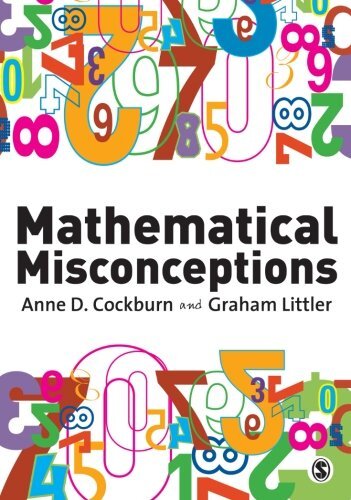
Item specifics
-
Condition
-
-
Title
-
Mathematical Misconceptions
-
ISBN
-
9781847874412
-
Subject Area
-
Mathematics, Education
-
Publication Name
-
Mathematical Misconceptions : a Guide for Primary Teachers
-
Publisher
-
SAGE Publications, The Limited
-
Item Length
-
9.4 in
-
Subject
-
General, Elementary, Number Theory, Teaching Methods & Materials / Mathematics
-
Publication Year
-
2008
-
Type
-
Textbook
-
Format
-
Trade Paperback
-
Language
-
English
-
Item Height
-
0.5 in
-
Item Weight
-
11 Oz
-
Item Width
-
6.6 in
-
Number of Pages
-
176 Pages
Mathematical Misconceptions: A Guide for Primary Teachers
About this product
Product Identifiers
Publisher
SAGE Publications, The Limited
ISBN-10
184787441X
ISBN-13
9781847874412
eBay Product ID (ePID)
18038684182
Product Key Features
Number of Pages
176 Pages
Publication Name
Mathematical Misconceptions : a Guide for Primary Teachers
Language
English
Subject
General, Elementary, Number Theory, Teaching Methods & Materials / Mathematics
Publication Year
2008
Type
Textbook
Subject Area
Mathematics, Education
Format
Trade Paperback
Dimensions
Item Height
0.5 in
Item Weight
11 Oz
Item Length
9.4 in
Item Width
6.6 in
Additional Product Features
Intended Audience
College Audience
Dewey Edition
22
Reviews
‘This book is a really interesting and useful volume…Each chapter has many questions, helpfully highlighted in boxes, so that the reader has the opportunity to pause and reflect. For me these questions turn this book from being good to excellent. Encouragingme to take the time to think about my own practice helps this book ask difficult but interesting questions. [It] is clearly aimed at primary teachers but I’m sure that secondary teachers would benefit hugely from this as well…I’m sure it will prompt useful and interesting discussions’ – Association of Teachers of Mathematics ‘As a secondary teacher of mathematics I’ve found this a remarkable insight into the student’s thinking – giving me clear background information to help me think about my classes and their misconceptions and how I could help the children develop their thinking’ – Association of Teachers of Mathematics — H.P. Koirala * CHOICE magazine * ‘This book is a really interesting and useful volume…Each chapter has many questions, helpfully highlighted in boxes, so that the reader has the opportunity to pause and reflect. For me these questions turn this book from being good to excellent. Encouragingme to take the time to think about my own practice helps this book ask difficult but interesting questions. [It] is clearly aimed at primary teachers but I’m sure that secondary teachers would benefit hugely from this as well…I’m sure it will prompt useful and interesting discussions’ – Association of Teachers of Mathematics ‘As a secondary teacher of mathematics I’ve found this a remarkable insight into the student’s thinking – giving me clear background information to help me think about my classes and their misconceptions and how I could help the children develop their thinking’ – Association of Teachers of Mathematics, The book is a valuable resource for mathematics education researchers focusing on elementary schoolchildren’s understanding of mathematics., ‘This book is a really interesting and useful volume…Each chapter has many questions, helpfully highlighted in boxes, so that the reader has the opportunity to pause and reflect. For me these questions turn this book from being good to excellent. Encouragingme to take the time to think about my own practice helps this book ask difficult but interesting questions. [It] is clearly aimed at primary teachers but I’m sure that secondary teachers would benefit hugely from this as well…I’m sure it will prompt useful and interesting discussions’ – Association of Teachers of Mathematics ‘As a secondary teacher of mathematics I’ve found this a remarkable insight into the student’s thinking – giving me clear background information to help me think about my classes and their misconceptions and how I could help the children develop their thinking’ – Association of Teachers of Mathematics, ‘This book is a really interesting and useful volume…Each chapter has many questions, helpfully highlighted in boxes, so that the reader has the opportunity to pause and reflect. For me these questions turn this book from being good to excellent. Encouragingme to take the time to think about my own practice helps this book ask difficult but interesting questions. [It] is clearly aimed at primary teachers but I’m sure that secondary teachers would benefit hugely from this as well…I’m sure it will prompt useful and interesting discussions’ – Association of Teachers of Mathematics’As a secondary teacher of mathematics I’ve found this a remarkable insight into the student’s thinking – giving me clear background information to help me think about my classes and their misconceptions and how I could help the children develop their thinking’ – Association of Teachers of Mathematics
Illustrated
Yes
Dewey Decimal
372.7
Table Of Content
Zero: understanding an apparently paradoxical number – Anne d Cockburn and Paul Parslow-Williams Equality: Getting the right balance – Paul Parslow-Williams and Anne D Cockburn Beginning to unravel misconceptions – Sara Hershkovitz, Dina Tirosh and Pessia Tsamir Insights into children’s intuitions of addition, subtraction, multiplication and division – Dina Tirosh, Pessia Tsamir and Sara Hershkovitz Right or Wrong? Exploring misconceptions in division – Pessia Tsamir, Sara Hershkovitz and Dina Tirosh Developing an understanding of children’s acquisition of number concepts – Anne D Cockburn Highlighting the learning processes – Graham Littler and Darina Jirotkova Everyday numbers under a mathematical magnifying glass – Carlo Marchini and Paoloa Vighi
Edition Description
Teacher’s edition
Synopsis
How do children relate to numbers and mathematics? How can they be helped to understand and make sense of them? People are rarely ambivalent towards mathematics, having either a love or hate relationship with the subject, and our approach to it is influenced by a variety of factors. How we are taught mathematics as children plays a big role in our feelings towards it. Numbers play a large part in our lives, and it is therefore beneficial to inspire a positive attitude towards them at a young age. With contributors comprised of teachers, teacher educators, mathematicians and psychologists, Mathematical Misconceptions brings together information about pupils work from four different countries, and looks at how children, from the ages of 3 – 11, think about numbers and use them. It explores the reasons for their successes, misunderstandings and misconceptions, while also broadening the readers own mathematical knowledge. Chapters explore: – the seemingly paradoxical number zero – the concept of equality – childrens perceptions and misconceptions of adding, subtracting, multiplying and dividing – the learning process – the ways in which children acquire number concepts. This unique book will transform the way in which primary school teachers think about mathematics. Fascinating reading for anyone working with children of this age, it will be of particular interest to teachers, trainee teachers and teaching assistants. It will show them how to engage children in the mysteries and delights of numbers., How do children relate to numbers and mathematics? How can they be helped to understand and make sense of them? People are rarely ambivalent towards mathematics, having either a love or hate relationship with the subject, and our approach to it is influenced by a variety of factors. How we are taught mathematics as children plays a big role in our feelings towards it. Numbers play a large part in our lives, and it is therefore beneficial to inspire a positive attitude towards them at a young age. With contributors comprised of teachers, teacher educators, mathematicians and psychologists, Mathematical Misconceptions brings together information about pupils’ work from four different countries, and looks at how children, from the ages of 3 – 11, think about numbers and use them. It explores the reasons for their successes, misunderstandings and misconceptions, while also broadening the reader’s own mathematical knowledge. Chapters explore: – the seemingly paradoxical number zero – the concept of equality – children’s perceptions and misconceptions of adding, subtracting, multiplying and dividing – the learning process – the ways in which children acquire number concepts. This unique book will transform the way in which primary school teachers think about mathematics. Fascinating reading for anyone working with children of this age, it will be of particular interest to teachers, trainee teachers and teaching assistants. It will show them how to engage children in the mysteries and delights of numbers., This book dispells the common misconceptions in maths and helps teachers inspire a succesful understanding and engagement of number learning, The Pimsleur(R) Method: the easiest, fastest way to learn a new language. Completely portable, easily downloadable, and lots of fun. You ll be speaking and understanding in no time flat English for Persian Phase 1, Unit 30 builds on material taught in prior units. It includes 30 minutes of spoken language practice, with an introductory conversation, new vocabulary, and new structures. Detailed instructions enable you to understand and participate in the conversation. The lesson contains full practice for all vocabulary introduced in this unit and in previous units. The emphasis is on pronunciation and comprehension, and on learning to “speak” English. Reading Lessons are included at the end of this unit to provide you with an introduction to reading English. These lessons, which total about one hour, are designed to teach you to sound out words with correct pronunciation and accent. A Reading Booklet to be used with the audio lessons is also included in PDF format.
LC Classification Number
QA135.5
Price : 9.79
Ends on : N/A
View on eBay