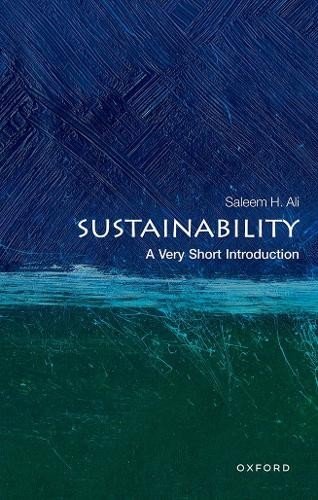
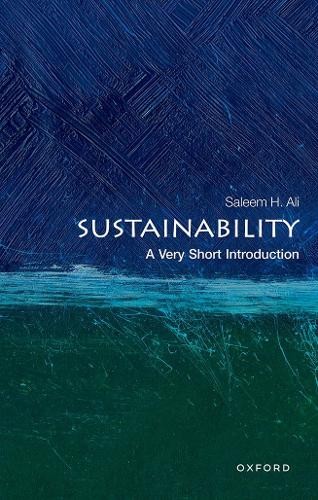
Saleem H. Ali Sustainability (Paperback) Very Short Introductions

$17.54

Item specifics

Condition
Brand New: A new, unread, unused book in perfect condition with no missing or damaged pages. See the …

Country of Origin
GB
Publication Name
Sustainability
Subtitle
A Very Short Introduction
ISBN-10
0192869620
EAN
9780192869623
ISBN
9780192869623
Release Year
2025
Release Date
01/23/2025
Series
Very Short Introductions
Book Title
Sustainability : a Very Short Introduction
Book Series
Very Short Introductions Ser.
Publisher
Oxford University Press, Incorporated
Item Length
6.9 in
Publication Year
2025
Format
Trade Paperback
Language
English
Illustrator
Yes
Item Height
0.4 in
Author
Saleem H. Ali
Genre
Nature, Business & Economics
Topic
Economic History, General
Item Weight
5.3 Oz
Item Width
4.4 in
Number of Pages
176 Pages

Saleem H. Ali Sustainability (Paperback) Very Short Introductions

About this product

Product Identifiers

Publisher
Oxford University Press, Incorporated
ISBN-10
0192869620
ISBN-13
9780192869623
eBay Product ID (ePID)
7062757837

Product Key Features

Book Title
Sustainability : a Very Short Introduction
Number of Pages
176 Pages
Language
English
Topic
Economic History, General
Publication Year
2025
Illustrator
Yes
Genre
Nature, Business & Economics
Author
Saleem H. Ali
Book Series
Very Short Introductions Ser.
Format
Trade Paperback

Dimensions

Item Height
0.4 in
Item Weight
5.3 Oz
Item Length
6.9 in
Item Width
4.4 in

Additional Product Features

Intended Audience
Trade
Reviews
“The pursuit of sustainability is entraining such an extraordinary flourishing of hopes, ideas, inventions and scams that it surely warrants its own World Expo in the near future. Fortunately, Saleem H. Ali has already gifted us what amounts to a catalog of what that Expo should have on display. He takes us on a critical tour of expected pavilions – nature’s services, circular systems, well-being metrics, tipping points, governance innovations and more. But he also introduces us to an eclectic selection of the people – scholars, activists, artists – who have helped to build those pavilions, to connect them, and so to foster today’s halting but real progress toward sustainable development. A must read, and an enjoyable one.” — William C. Clark, Harvey Brooks Research Professor, Harvard University, Member of the U.S. National Academy of Sciences”Sustainability science has come a long way, moving from integrated environmental science to social-ecological systems research for a prosperous and equitable future for people on planet Earth. The key insight is not that humanity faces potentially unmanageable environmental risks. It is that we have increasing evidence that sustainability is the only path to a healthier, more stable and modern future. Summarizing this journey and the state of knowledge is no small feat. Saleem Ali succeeds, in a must read for all who want to succeed in the future.” — Johan Rockström, Professor in Earth system science, Director of the Potsdam Institute for Climate Impact Research, Winner of the Tyler Prize for Environmental Achievement”If you are beginning to explore the idea of sustainability, there is no better starting point than Ali’s tour. And even if you are an expert, Ali’s integrative view will help you connect diverse approaches and frameworks into a more comprehensive understanding. Sustainability itself is a complex topic and it immediately engages with other important concepts and approaches, including ecological economics, industrial ecology, life cycle analysis, planetary boundaries, tipping points, and many more. This short volume gives a coherent overview showing the links between key ideas while noting their history.” — Thomas Dietz, University Distinguished Professor, Michigan State University, Member of the U.S. National Academy of Sciences, Author: Decisions for Sustainability”If you are beginning to explore the idea of sustainability, there is no better starting point than Ali’s tour. And even if you are an expert, Ali’s integrative view will help you connect diverse approaches and frameworks into a more comprehensive understanding. Sustainability itself is a complex topic and it immediately engages with other important concepts and approaches, including ecological economics, industrial ecology, life cycle analysis, planetary boundaries, tipping points, and many more. This short volume gives a coherent overview showing the links between key ideas while noting their history.” — Thomas Dietz, University Distinguished Professor, Michigan State University, Member of the U.S. National Academy of Sciences, Author: Decisions for Sustainability, “The pursuit of sustainability is entraining such an extraordinary flourishing of hopes, ideas, inventions and scams that it surely warrants its own World Expo in the near future. Fortunately, Saleem H. Ali has already gifted us what amounts to a catalog of what that Expo should have on display. He takes us on a critical tour of expected pavilions – nature’s services, circular systems, well-being metrics, tipping points, governance innovations and more. But he also introduces us to an eclectic selection of the people – scholars, activists, artists – who have helped to build those pavilions, to connect them, and so to foster today’s halting but real progress toward sustainable development. A must read, and an enjoyable one.” — William C. Clark, Harvey Brooks Research Professor, Harvard University, Member of the U.S. National Academy of Sciences”Sustainability science has come a long way, moving from integrated environmental science to social-ecological systems research for a prosperous and equitable future for people on planet Earth. The key insight is not that humanity faces potentially unmanageable environmental risks. It is that we have increasing evidence that sustainability is the only path to a healthier, more stable and modern future. Summarizing this journey and the state of knowledge is no small feat. Saleem Ali succeeds, in a must read for all who want to succeed in the future.” — Johan Rockström, Professor in Earth system science, Director of the Potsdam Institute for Climate Impact Research, Winner of the Tyler Prize for Environmental Achievement”The pursuit of sustainability is entraining such an extraordinary flourishing of hopes, ideas, inventions and scams that it surely warrants its own World Expo in the near future. Fortunately, Saleem H. Ali has already gifted us what amounts to a catalog of what that Expo should have on display. He takes us on a critical tour of expected pavilions – nature’s services, circular systems, well-being metrics, tipping points, governance innovations and more. But he also introduces us to an eclectic selection of the people – scholars, activists, artists – who have helped to build those pavilions, to connect them, and so to foster today’s halting but real progress toward sustainable development. A must read, and an enjoyable one.” — William C. Clark, Harvey Brooks Research Professor, Harvard University, Member of the U.S. National Academy of Sciences, “The pursuit of sustainability is entraining such an extraordinary flourishing of hopes, ideas, inventions and scams that it surely warrants its own World Expo in the near future. Fortunately, Saleem H. Ali has already gifted us what amounts to a catalog of what that Expo should have on display. He takes us on a critical tour of expected pavilions – nature’s services, circular systems, well-being metrics, tipping points, governance innovations and more. But he also introduces us to an eclectic selection of the people – scholars, activists, artists – who have helped to build those pavilions, to connect them, and so to foster today’s halting but real progress toward sustainable development. A must read, and an enjoyable one.” — William C. Clark, Harvey Brooks Research Professor, Harvard University, Member of the U.S. National Academy of Sciences”Sustainability science has come a long way, moving from integrated environmental science to social-ecological systems research for a prosperous and equitable future for people on planet Earth. The key insight is not that humanity faces potentially unmanageable environmental risks. It is that we have increasing evidence that sustainability is the only path to a healthier, more stable and modern future. Summarizing this journey and the state of knowledge is no small feat. Saleem Ali succeeds, in a must read for all who want to succeed in the future.” — Johan Rockström, Professor in Earth system science, Director of the Potsdam Institute for Climate Impact Research, Winner of the Tyler Prize for Environmental Achievement, “The pursuit of sustainability is entraining such an extraordinary flourishing of hopes, ideas, inventions and scams that it surely warrants its own World Expo in the near future. Fortunately, Saleem H. Ali has already gifted us what amounts to a catalog of what that Expo should have on display. He takes us on a critical tour of expected pavilions – nature’s services, circular systems, well-being metrics, tipping points, governance innovations and more. But he also introduces us to an eclectic selection of the people – scholars, activists, artists – who have helped to build those pavilions, to connect them, and so to foster today’s halting but real progress toward sustainable development. A must read, and an enjoyable one.” — William C. Clark, Harvey Brooks Research Professor, Harvard University, Member of the U.S. National Academy of Sciences”Sustainability science has come a long way, moving from integrated environmental science to social-ecological systems research for a prosperous and equitable future for people on planet Earth. The key insight is not that humanity faces potentially unmanageable environmental risks. It is that we have increasing evidence that sustainability is the only path to a healthier, more stable and modern future. Summarizing this journey and the state of knowledge is no small feat. Saleem Ali succeeds, in a must read for all who want to succeed in the future.” — Johan Rockström, Professor in Earth system science, Director of the Potsdam Institute for Climate Impact Research, Winner of the Tyler Prize for Environmental Achievement”If you are beginning to explore the idea of sustainability, there is no better starting point than Ali’s tour. And even if you are an expert, Ali’s integrative view will help you connect diverse approaches and frameworks into a more comprehensive understanding. Sustainability itself is a complex topic and it immediately engages with other important concepts and approaches, including ecological economics, industrial ecology, life cycle analysis, planetary boundaries, tipping points, and many more. This short volume gives a coherent overview showing the links between key ideas while noting their history.” — Thomas Dietz, University Distinguished Professor, Michigan State University, Member of the U.S. National Academy of Sciences, Author: Decisions for Sustainability
Dewey Edition
23
Dewey Decimal
338.927
Table Of Content
1. Seeking ‘sustainability’: origins and concepts2. How energy and materials flow through systems3. Technological and economic interventions for a sustainable society4. Tipping points and resilience5. Renewability, circularity, and industry6. Anthropogenic change and sustainability
Synopsis
The growing concern about global environmental change and human impacts on the planet has led to the emergence of a broad field of study on the ‘sustainability’ of human societies. This Very Short Introductioninvestigates the concept of sustainability and how it has developed, before highlighting the four key concepts crucial to sustainability: material and energy flows in consumption and production; technological interventions for a sustainable society; tipping points, and resilience in natural and social systems; and renewability and circularity in the economy. Saleem H. Ali also explores political means of managing anthropogenic change for a more sustainable society., Sustainability has gained wide currency as an aspirational concept for humans to pursue in their relationship with our planet. This book provides a succinct overview of the scientific and social foundations of sustainability that can be used by individuals, corporations, and governments as a means of charting a more viable future., Very Short Introductions: Brilliant, Sharp, InspiringThe growing concern about global environmental change and human impacts on the planet has led to the emergence of a broad field of study on the ‘sustainability’ of human societies. The term’s common usage can be traced back to the advent of the Earth Summit in 1992 when ‘sustainable development’ was broadly embraced by the international community as an ostensibly win-win proposition for economic development, social inclusion, and ecological conservation. Yet both the natural science underpinnings and the social implications of a quest for sustainability have been diffuse. There is a need for a coherent synthesis which draws out key themes from both natural and social analysis of the concept.This Very Short Introduction begins by introducing the concept of sustainability and how it has developed. The central chapters consider four key concepts crucial to sustainability: a) material and energy flows in consumption and production; b) technological interventions for a sustainable society; c) tipping points, and resilience in natural and social systems; and d) renewability and circularity in the economy. In the concluding chapter, Saleem Ali explores political means of managing anthropogenic change for a more sustainable society.ABOUT THE SERIES: The Very Short Introductions series from Oxford University Press contains hundreds of titles in almost every subject area. These pocket-sized books are the perfect way to get ahead in a new subject quickly. Our expert authors combine facts, analysis, perspective, new ideas, and enthusiasm to make interesting and challenging topics highly readable., Very Short Introductions : Brilliant, Sharp, Inspiring The growing concern about global environmental change and human impacts on the planet has led to the emergence of a broad field of study on the ‘sustainability’ of human societies. The term’s common usage can be traced back to the advent of the Earth Summit in 1992 when ‘sustainable development’ was broadly embraced by the international community as an ostensibly win-win proposition for economic development, social inclusion, and ecological conservation. Yet both the natural science underpinnings and the social implications of a quest for sustainability have been diffuse. There is a need for a coherent synthesis which draws out key themes from both natural and social analysis of the concept.This Very Short Introduction begins by introducing the concept of sustainability and how it has developed. The central chapters consider four key concepts crucial to sustainability: a) material and energy flows in consumption and production; b) technological interventions for a sustainable society; c) tipping points, and resilience in natural and social systems; and d) renewability and circularity in the economy. In the concluding chapter, Saleem H. Ali explores political means of managing anthropogenic change for a more sustainable society.ABOUT THE SERIES: The Very Short Introductions series from Oxford University Press contains hundreds of titles in almost every subject area. These pocket-sized books are the perfect way to get ahead in a new subject quickly. Our expert authors combine facts, analysis, perspective, new ideas, and enthusiasm to make interesting and challenging topics highly readable.
LC Classification Number
HC79.E5A4 2024

Description


Item specifics

Condition
Brand New: A new, unread, unused book in perfect condition with no missing or damaged pages. See the …

Country of Origin
GB
Publication Name
Sustainability
Subtitle
A Very Short Introduction
ISBN-10
0192869620
EAN
9780192869623
ISBN
9780192869623
Release Year
2025
Release Date
01/23/2025
Series
Very Short Introductions
Book Title
Sustainability : a Very Short Introduction
Book Series
Very Short Introductions Ser.
Publisher
Oxford University Press, Incorporated
Item Length
6.9 in
Publication Year
2025
Format
Trade Paperback
Language
English
Illustrator
Yes
Item Height
0.4 in
Author
Saleem H. Ali
Genre
Nature, Business & Economics
Topic
Economic History, General
Item Weight
5.3 Oz
Item Width
4.4 in
Number of Pages
176 Pages

Saleem H. Ali Sustainability (Paperback) Very Short Introductions

About this product

Product Identifiers

Publisher
Oxford University Press, Incorporated
ISBN-10
0192869620
ISBN-13
9780192869623
eBay Product ID (ePID)
7062757837

Product Key Features

Book Title
Sustainability : a Very Short Introduction
Number of Pages
176 Pages
Language
English
Topic
Economic History, General
Publication Year
2025
Illustrator
Yes
Genre
Nature, Business & Economics
Author
Saleem H. Ali
Book Series
Very Short Introductions Ser.
Format
Trade Paperback

Dimensions

Item Height
0.4 in
Item Weight
5.3 Oz
Item Length
6.9 in
Item Width
4.4 in

Additional Product Features

Intended Audience
Trade
Reviews
“The pursuit of sustainability is entraining such an extraordinary flourishing of hopes, ideas, inventions and scams that it surely warrants its own World Expo in the near future. Fortunately, Saleem H. Ali has already gifted us what amounts to a catalog of what that Expo should have on display. He takes us on a critical tour of expected pavilions – nature’s services, circular systems, well-being metrics, tipping points, governance innovations and more. But he also introduces us to an eclectic selection of the people – scholars, activists, artists – who have helped to build those pavilions, to connect them, and so to foster today’s halting but real progress toward sustainable development. A must read, and an enjoyable one.” — William C. Clark, Harvey Brooks Research Professor, Harvard University, Member of the U.S. National Academy of Sciences”Sustainability science has come a long way, moving from integrated environmental science to social-ecological systems research for a prosperous and equitable future for people on planet Earth. The key insight is not that humanity faces potentially unmanageable environmental risks. It is that we have increasing evidence that sustainability is the only path to a healthier, more stable and modern future. Summarizing this journey and the state of knowledge is no small feat. Saleem Ali succeeds, in a must read for all who want to succeed in the future.” — Johan Rockström, Professor in Earth system science, Director of the Potsdam Institute for Climate Impact Research, Winner of the Tyler Prize for Environmental Achievement”If you are beginning to explore the idea of sustainability, there is no better starting point than Ali’s tour. And even if you are an expert, Ali’s integrative view will help you connect diverse approaches and frameworks into a more comprehensive understanding. Sustainability itself is a complex topic and it immediately engages with other important concepts and approaches, including ecological economics, industrial ecology, life cycle analysis, planetary boundaries, tipping points, and many more. This short volume gives a coherent overview showing the links between key ideas while noting their history.” — Thomas Dietz, University Distinguished Professor, Michigan State University, Member of the U.S. National Academy of Sciences, Author: Decisions for Sustainability”If you are beginning to explore the idea of sustainability, there is no better starting point than Ali’s tour. And even if you are an expert, Ali’s integrative view will help you connect diverse approaches and frameworks into a more comprehensive understanding. Sustainability itself is a complex topic and it immediately engages with other important concepts and approaches, including ecological economics, industrial ecology, life cycle analysis, planetary boundaries, tipping points, and many more. This short volume gives a coherent overview showing the links between key ideas while noting their history.” — Thomas Dietz, University Distinguished Professor, Michigan State University, Member of the U.S. National Academy of Sciences, Author: Decisions for Sustainability, “The pursuit of sustainability is entraining such an extraordinary flourishing of hopes, ideas, inventions and scams that it surely warrants its own World Expo in the near future. Fortunately, Saleem H. Ali has already gifted us what amounts to a catalog of what that Expo should have on display. He takes us on a critical tour of expected pavilions – nature’s services, circular systems, well-being metrics, tipping points, governance innovations and more. But he also introduces us to an eclectic selection of the people – scholars, activists, artists – who have helped to build those pavilions, to connect them, and so to foster today’s halting but real progress toward sustainable development. A must read, and an enjoyable one.” — William C. Clark, Harvey Brooks Research Professor, Harvard University, Member of the U.S. National Academy of Sciences”Sustainability science has come a long way, moving from integrated environmental science to social-ecological systems research for a prosperous and equitable future for people on planet Earth. The key insight is not that humanity faces potentially unmanageable environmental risks. It is that we have increasing evidence that sustainability is the only path to a healthier, more stable and modern future. Summarizing this journey and the state of knowledge is no small feat. Saleem Ali succeeds, in a must read for all who want to succeed in the future.” — Johan Rockström, Professor in Earth system science, Director of the Potsdam Institute for Climate Impact Research, Winner of the Tyler Prize for Environmental Achievement”The pursuit of sustainability is entraining such an extraordinary flourishing of hopes, ideas, inventions and scams that it surely warrants its own World Expo in the near future. Fortunately, Saleem H. Ali has already gifted us what amounts to a catalog of what that Expo should have on display. He takes us on a critical tour of expected pavilions – nature’s services, circular systems, well-being metrics, tipping points, governance innovations and more. But he also introduces us to an eclectic selection of the people – scholars, activists, artists – who have helped to build those pavilions, to connect them, and so to foster today’s halting but real progress toward sustainable development. A must read, and an enjoyable one.” — William C. Clark, Harvey Brooks Research Professor, Harvard University, Member of the U.S. National Academy of Sciences, “The pursuit of sustainability is entraining such an extraordinary flourishing of hopes, ideas, inventions and scams that it surely warrants its own World Expo in the near future. Fortunately, Saleem H. Ali has already gifted us what amounts to a catalog of what that Expo should have on display. He takes us on a critical tour of expected pavilions – nature’s services, circular systems, well-being metrics, tipping points, governance innovations and more. But he also introduces us to an eclectic selection of the people – scholars, activists, artists – who have helped to build those pavilions, to connect them, and so to foster today’s halting but real progress toward sustainable development. A must read, and an enjoyable one.” — William C. Clark, Harvey Brooks Research Professor, Harvard University, Member of the U.S. National Academy of Sciences”Sustainability science has come a long way, moving from integrated environmental science to social-ecological systems research for a prosperous and equitable future for people on planet Earth. The key insight is not that humanity faces potentially unmanageable environmental risks. It is that we have increasing evidence that sustainability is the only path to a healthier, more stable and modern future. Summarizing this journey and the state of knowledge is no small feat. Saleem Ali succeeds, in a must read for all who want to succeed in the future.” — Johan Rockström, Professor in Earth system science, Director of the Potsdam Institute for Climate Impact Research, Winner of the Tyler Prize for Environmental Achievement, “The pursuit of sustainability is entraining such an extraordinary flourishing of hopes, ideas, inventions and scams that it surely warrants its own World Expo in the near future. Fortunately, Saleem H. Ali has already gifted us what amounts to a catalog of what that Expo should have on display. He takes us on a critical tour of expected pavilions – nature’s services, circular systems, well-being metrics, tipping points, governance innovations and more. But he also introduces us to an eclectic selection of the people – scholars, activists, artists – who have helped to build those pavilions, to connect them, and so to foster today’s halting but real progress toward sustainable development. A must read, and an enjoyable one.” — William C. Clark, Harvey Brooks Research Professor, Harvard University, Member of the U.S. National Academy of Sciences”Sustainability science has come a long way, moving from integrated environmental science to social-ecological systems research for a prosperous and equitable future for people on planet Earth. The key insight is not that humanity faces potentially unmanageable environmental risks. It is that we have increasing evidence that sustainability is the only path to a healthier, more stable and modern future. Summarizing this journey and the state of knowledge is no small feat. Saleem Ali succeeds, in a must read for all who want to succeed in the future.” — Johan Rockström, Professor in Earth system science, Director of the Potsdam Institute for Climate Impact Research, Winner of the Tyler Prize for Environmental Achievement”If you are beginning to explore the idea of sustainability, there is no better starting point than Ali’s tour. And even if you are an expert, Ali’s integrative view will help you connect diverse approaches and frameworks into a more comprehensive understanding. Sustainability itself is a complex topic and it immediately engages with other important concepts and approaches, including ecological economics, industrial ecology, life cycle analysis, planetary boundaries, tipping points, and many more. This short volume gives a coherent overview showing the links between key ideas while noting their history.” — Thomas Dietz, University Distinguished Professor, Michigan State University, Member of the U.S. National Academy of Sciences, Author: Decisions for Sustainability
Dewey Edition
23
Dewey Decimal
338.927
Table Of Content
1. Seeking ‘sustainability’: origins and concepts2. How energy and materials flow through systems3. Technological and economic interventions for a sustainable society4. Tipping points and resilience5. Renewability, circularity, and industry6. Anthropogenic change and sustainability
Synopsis
The growing concern about global environmental change and human impacts on the planet has led to the emergence of a broad field of study on the ‘sustainability’ of human societies. This Very Short Introductioninvestigates the concept of sustainability and how it has developed, before highlighting the four key concepts crucial to sustainability: material and energy flows in consumption and production; technological interventions for a sustainable society; tipping points, and resilience in natural and social systems; and renewability and circularity in the economy. Saleem H. Ali also explores political means of managing anthropogenic change for a more sustainable society., Sustainability has gained wide currency as an aspirational concept for humans to pursue in their relationship with our planet. This book provides a succinct overview of the scientific and social foundations of sustainability that can be used by individuals, corporations, and governments as a means of charting a more viable future., Very Short Introductions: Brilliant, Sharp, InspiringThe growing concern about global environmental change and human impacts on the planet has led to the emergence of a broad field of study on the ‘sustainability’ of human societies. The term’s common usage can be traced back to the advent of the Earth Summit in 1992 when ‘sustainable development’ was broadly embraced by the international community as an ostensibly win-win proposition for economic development, social inclusion, and ecological conservation. Yet both the natural science underpinnings and the social implications of a quest for sustainability have been diffuse. There is a need for a coherent synthesis which draws out key themes from both natural and social analysis of the concept.This Very Short Introduction begins by introducing the concept of sustainability and how it has developed. The central chapters consider four key concepts crucial to sustainability: a) material and energy flows in consumption and production; b) technological interventions for a sustainable society; c) tipping points, and resilience in natural and social systems; and d) renewability and circularity in the economy. In the concluding chapter, Saleem Ali explores political means of managing anthropogenic change for a more sustainable society.ABOUT THE SERIES: The Very Short Introductions series from Oxford University Press contains hundreds of titles in almost every subject area. These pocket-sized books are the perfect way to get ahead in a new subject quickly. Our expert authors combine facts, analysis, perspective, new ideas, and enthusiasm to make interesting and challenging topics highly readable., Very Short Introductions : Brilliant, Sharp, Inspiring The growing concern about global environmental change and human impacts on the planet has led to the emergence of a broad field of study on the ‘sustainability’ of human societies. The term’s common usage can be traced back to the advent of the Earth Summit in 1992 when ‘sustainable development’ was broadly embraced by the international community as an ostensibly win-win proposition for economic development, social inclusion, and ecological conservation. Yet both the natural science underpinnings and the social implications of a quest for sustainability have been diffuse. There is a need for a coherent synthesis which draws out key themes from both natural and social analysis of the concept.This Very Short Introduction begins by introducing the concept of sustainability and how it has developed. The central chapters consider four key concepts crucial to sustainability: a) material and energy flows in consumption and production; b) technological interventions for a sustainable society; c) tipping points, and resilience in natural and social systems; and d) renewability and circularity in the economy. In the concluding chapter, Saleem H. Ali explores political means of managing anthropogenic change for a more sustainable society.ABOUT THE SERIES: The Very Short Introductions series from Oxford University Press contains hundreds of titles in almost every subject area. These pocket-sized books are the perfect way to get ahead in a new subject quickly. Our expert authors combine facts, analysis, perspective, new ideas, and enthusiasm to make interesting and challenging topics highly readable.
LC Classification Number
HC79.E5A4 2024

Price : 17.54

Ends on : N/A

View on eBay

We use cookies to ensure that we give you the best experience on our website.