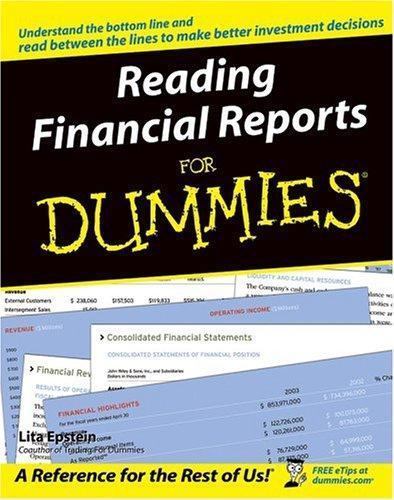
Reading Financial Reports for Dummies by Epstein, Lita

$5.14

Item specifics

Condition
Good

A book that has been read but is in good condition. Very minimal damage to the cover including scuff marks, but no holes or tears. The dust jacket for hard covers may not be included. Binding has minimal wear. The majority of pages are undamaged with minimal creasing or tearing, minimal pencil underlining of text, no highlighting of text, no writing in margins. No missing pages. See the seller’s listing for full details and description of any imperfections. See all condition definitionsopens in a new window or tab

Seller Notes
“Pages can have notes/highlighting. Spine may show signs of wear. ~ ThriftBooks: Read More, …

Binding
Paperback
Weight
1 lbs
Product Group
Book
IsTextBook
No
ISBN
9780764577338
Book Title
Reading Financial Reports for Dummies
Publisher
Wiley & Sons, Incorporated, John
Item Length
9.1 in
Publication Year
2004
Format
Trade Paperback
Language
English
Illustrator
Yes
Item Height
0.7 in
Author
Lita Epstein
Genre
Business & Economics
Topic
Finance / General, Accounting / General
Item Weight
19.2 Oz
Item Width
7.3 in
Number of Pages
384 Pages

Reading Financial Reports for Dummies by Epstein, Lita

About this product

Product Identifiers

Publisher
Wiley & Sons, Incorporated, John
ISBN-10
0764577336
ISBN-13
9780764577338
eBay Product ID (ePID)
31004205

Product Key Features

Book Title
Reading Financial Reports for Dummies
Number of Pages
384 Pages
Language
English
Publication Year
2004
Topic
Finance / General, Accounting / General
Illustrator
Yes
Genre
Business & Economics
Author
Lita Epstein
Format
Trade Paperback

Dimensions

Item Height
0.7 in
Item Weight
19.2 Oz
Item Length
9.1 in
Item Width
7.3 in

Additional Product Features

Intended Audience
Trade
LCCN
2004-116012
Dewey Edition
22
Dewey Decimal
332.63/2042
Table Of Content
Introduction.Part I: Getting Down to Financial Reporting Basics.Chapter 1: Opening the Cornucopia of Reports.Chapter 2: Recognizing Different Business Types.Chapter 3: How Company Structure Affects the Books.Chapter 4: Digging Into Accounting Basics.Part II: Checking Out the Big Show: Annual Reports.Chapter 5: Exploring the Anatomy of an Annual Report.Chapter 6: Balancing Assets against Liabilities and Equity.Chapter 7: Using the Income Statement.Chapter 8: The Statement of Cash Flows.Chapter 9: Scouring the Notes to the Financial Statements.Chapter 10: Considering Consolidated Financial Statements.Part III: Analyzing the Numbers.Chapter 11: Testing the Profits and Market Value.Chapter 12: Looking at Liquidity.Chapter 13: Making Sure the Company Has Cash to Carry On.Part IV: Understanding How Companies Optimize Operations.Chapter 14: Using Basic Budgeting.Chapter 15: Turning Up Clues in Turnover and Assets.Chapter 16: Examining Cash Inflow and Outflow.Chapter 17: How Companies Keep the Cash Flowing.Part V: The Many Ways Companies Answer to Others.Chapter 18: Finding Out How Companies Find Errors: The Auditing Process.Chapter 19: Digging Into Government Regulations.Chapter 20: Checking Out the Analyst-Corporation Connection.Chapter 21: How Companies Soothe the Shareholders.Chapter 22: Keeping Score When Companies Play Games with Numbers.Part VI: The Part of Tens.Chapter 23: Ten Financial Scandals That Rocked the World.Chapter 24: Ten Signs That a Company’s in Trouble.Chapter 25: Ten Top-Notch Online Resources.Part VII: Appendixes.Appendix A: Financial Statements.Appendix B: Glossary.Index.
Synopsis
The U.S. government began standardizing and regulating financial reporting in 1929 when the stock market crash made it painfully clear that businesses often made absurd claims and that investors were either gullible, unable to verify information, or both. Now, financial reports are used by a company’s management to measure profitability (or lack of it), optimize operations and guide the company, by banks and other lenders to gauge the company’s financial health, and by institutional or individual investors interested in purchasing stock. Unless you’re financially savvy, annual reports with all those figures, frustrating footnotes, and fine print are boring and intimidating. However, once you have a fundamental knowledge of finance and its basic terminology, you can find the juicy parts. Reading Financial Reports For Dummies by Lita Epstein, a teacher of online financial courses and author of Trading for Dummies , gets you up to speed so you can: Go past the prose that can maximize the positive and minimize the negative and get information in dollars and cents Get an overview from the big three-the balance sheet, income statement, and statement of cash flows Understand the lingo and read between the lines Calculate basics like PE, Dividend Payout Ratio, ROS, ROA, ROE, Operating Margin, and Net Margin It pays for investors to be somewhat skeptical instead of gullible. Pressured to please Wall Street, companies are sometimes tempted to use “creative” accounting. You’ll discover how to: Detect red flags (that, unfortunately, aren’t emphasized in red) such as lawsuits, changes in accounting methods, and obligations to retirees and future retirees Understand the different reporting requirements for public companies and private companies with various types of business structures Analyze a company’s cash flow, a prime indicator of its financial health Scrutinize deals such as mergers, acquisitions, liquidations and other major changes in key assets Organized so you can start where you’re comfortable and proceed at your own pace, Reading Financial Reports for Dummies helps managers prepare annual reports and use financial reporting to budget more efficiently and helps investors base their decisions on knowledge instead of hype. Whether you’re in business or in the stock market, knowledge is always an asset., Simple strategies for measuring a company2s financial health Decipher the jargon and read financial reports like a pro Whether you2re a serious investor or hold a few shares in the company you work for, reading financial reports is a vital way to keep tabs on a company2s performance. This clear and friendly guide will help you wade through the numbers to see what2s really going on – so you can make smarter and more profitable investment choices. Discover how to: Make sense of balance sheets Find the figures that tell the tale Test the numbers with simple formulas Recognize red flags in the footnotes Understand deceptive accounting practices, Especially relevant in today’s climate of suspicion and corporate malfeasance, this helpful, straightforward guide helps readers mine financial reports for the vitally important information they reveal about a company-what shape it’s in and where it’s going., The U.S. government began standardizing and regulating financial reporting in 1929 when the stock market crash made it painfully clear that businesses often made absurd claims and that investors were either gullible, unable to verify information, or both. Now, financial reports are used by a company’s management to measure profitability (or lack of it), optimize operations and guide the company, by banks and other lenders to gauge the company’s financial health, and by institutional or individual investors interested in purchasing stock. Unless you’re financially savvy, annual reports with all those figures, frustrating footnotes, and fine print are boring and intimidating. However, once you have a fundamental knowledge of finance and its basic terminology, you can find the juicy parts. Reading Financial Reports For Dummies by Lita Epstein, a teacher of online financial courses and author of Trading for Dummies , gets you up to speed so you can: Go past the prose that can maximize the positive and minimize the negative and get information in dollars and cents Get an overview from the big three–the balance sheet, income statement, and statement of cash flows Understand the lingo and read between the lines Calculate basics like PE, Dividend Payout Ratio, ROS, ROA, ROE, Operating Margin, and Net Margin It pays for investors to be somewhat skeptical instead of gullible. Pressured to please Wall Street, companies are sometimes tempted to use “creative” accounting. You’ll discover how to: Detect red flags (that, unfortunately, aren’t emphasized in red) such as lawsuits, changes in accounting methods, and obligations to retirees and future retirees Understand the different reporting requirements for public companies and private companies with various types of business structures Analyze a company’s cash flow, a prime indicator of its financial health Scrutinize deals such as mergers, acquisitions, liquidations and other major changes in key assets Organized so you can start where you’re comfortable and proceed at your own pace, Reading Financial Reports for Dummies helps managers prepare annual reports and use financial reporting to budget more efficiently and helps investors base their decisions on knowledge instead of hype. Whether you’re in business or in the stock market, knowledge is always an asset.
LC Classification Number
HG4028.B2

Description


Item specifics

Condition
Good

A book that has been read but is in good condition. Very minimal damage to the cover including scuff marks, but no holes or tears. The dust jacket for hard covers may not be included. Binding has minimal wear. The majority of pages are undamaged with minimal creasing or tearing, minimal pencil underlining of text, no highlighting of text, no writing in margins. No missing pages. See the seller’s listing for full details and description of any imperfections. See all condition definitionsopens in a new window or tab

Seller Notes
“Pages can have notes/highlighting. Spine may show signs of wear. ~ ThriftBooks: Read More, …

Binding
Paperback
Weight
1 lbs
Product Group
Book
IsTextBook
No
ISBN
9780764577338
Book Title
Reading Financial Reports for Dummies
Publisher
Wiley & Sons, Incorporated, John
Item Length
9.1 in
Publication Year
2004
Format
Trade Paperback
Language
English
Illustrator
Yes
Item Height
0.7 in
Author
Lita Epstein
Genre
Business & Economics
Topic
Finance / General, Accounting / General
Item Weight
19.2 Oz
Item Width
7.3 in
Number of Pages
384 Pages

Reading Financial Reports for Dummies by Epstein, Lita

About this product

Product Identifiers

Publisher
Wiley & Sons, Incorporated, John
ISBN-10
0764577336
ISBN-13
9780764577338
eBay Product ID (ePID)
31004205

Product Key Features

Book Title
Reading Financial Reports for Dummies
Number of Pages
384 Pages
Language
English
Publication Year
2004
Topic
Finance / General, Accounting / General
Illustrator
Yes
Genre
Business & Economics
Author
Lita Epstein
Format
Trade Paperback

Dimensions

Item Height
0.7 in
Item Weight
19.2 Oz
Item Length
9.1 in
Item Width
7.3 in

Additional Product Features

Intended Audience
Trade
LCCN
2004-116012
Dewey Edition
22
Dewey Decimal
332.63/2042
Table Of Content
Introduction.Part I: Getting Down to Financial Reporting Basics.Chapter 1: Opening the Cornucopia of Reports.Chapter 2: Recognizing Different Business Types.Chapter 3: How Company Structure Affects the Books.Chapter 4: Digging Into Accounting Basics.Part II: Checking Out the Big Show: Annual Reports.Chapter 5: Exploring the Anatomy of an Annual Report.Chapter 6: Balancing Assets against Liabilities and Equity.Chapter 7: Using the Income Statement.Chapter 8: The Statement of Cash Flows.Chapter 9: Scouring the Notes to the Financial Statements.Chapter 10: Considering Consolidated Financial Statements.Part III: Analyzing the Numbers.Chapter 11: Testing the Profits and Market Value.Chapter 12: Looking at Liquidity.Chapter 13: Making Sure the Company Has Cash to Carry On.Part IV: Understanding How Companies Optimize Operations.Chapter 14: Using Basic Budgeting.Chapter 15: Turning Up Clues in Turnover and Assets.Chapter 16: Examining Cash Inflow and Outflow.Chapter 17: How Companies Keep the Cash Flowing.Part V: The Many Ways Companies Answer to Others.Chapter 18: Finding Out How Companies Find Errors: The Auditing Process.Chapter 19: Digging Into Government Regulations.Chapter 20: Checking Out the Analyst-Corporation Connection.Chapter 21: How Companies Soothe the Shareholders.Chapter 22: Keeping Score When Companies Play Games with Numbers.Part VI: The Part of Tens.Chapter 23: Ten Financial Scandals That Rocked the World.Chapter 24: Ten Signs That a Company’s in Trouble.Chapter 25: Ten Top-Notch Online Resources.Part VII: Appendixes.Appendix A: Financial Statements.Appendix B: Glossary.Index.
Synopsis
The U.S. government began standardizing and regulating financial reporting in 1929 when the stock market crash made it painfully clear that businesses often made absurd claims and that investors were either gullible, unable to verify information, or both. Now, financial reports are used by a company’s management to measure profitability (or lack of it), optimize operations and guide the company, by banks and other lenders to gauge the company’s financial health, and by institutional or individual investors interested in purchasing stock. Unless you’re financially savvy, annual reports with all those figures, frustrating footnotes, and fine print are boring and intimidating. However, once you have a fundamental knowledge of finance and its basic terminology, you can find the juicy parts. Reading Financial Reports For Dummies by Lita Epstein, a teacher of online financial courses and author of Trading for Dummies , gets you up to speed so you can: Go past the prose that can maximize the positive and minimize the negative and get information in dollars and cents Get an overview from the big three-the balance sheet, income statement, and statement of cash flows Understand the lingo and read between the lines Calculate basics like PE, Dividend Payout Ratio, ROS, ROA, ROE, Operating Margin, and Net Margin It pays for investors to be somewhat skeptical instead of gullible. Pressured to please Wall Street, companies are sometimes tempted to use “creative” accounting. You’ll discover how to: Detect red flags (that, unfortunately, aren’t emphasized in red) such as lawsuits, changes in accounting methods, and obligations to retirees and future retirees Understand the different reporting requirements for public companies and private companies with various types of business structures Analyze a company’s cash flow, a prime indicator of its financial health Scrutinize deals such as mergers, acquisitions, liquidations and other major changes in key assets Organized so you can start where you’re comfortable and proceed at your own pace, Reading Financial Reports for Dummies helps managers prepare annual reports and use financial reporting to budget more efficiently and helps investors base their decisions on knowledge instead of hype. Whether you’re in business or in the stock market, knowledge is always an asset., Simple strategies for measuring a company2s financial health Decipher the jargon and read financial reports like a pro Whether you2re a serious investor or hold a few shares in the company you work for, reading financial reports is a vital way to keep tabs on a company2s performance. This clear and friendly guide will help you wade through the numbers to see what2s really going on – so you can make smarter and more profitable investment choices. Discover how to: Make sense of balance sheets Find the figures that tell the tale Test the numbers with simple formulas Recognize red flags in the footnotes Understand deceptive accounting practices, Especially relevant in today’s climate of suspicion and corporate malfeasance, this helpful, straightforward guide helps readers mine financial reports for the vitally important information they reveal about a company-what shape it’s in and where it’s going., The U.S. government began standardizing and regulating financial reporting in 1929 when the stock market crash made it painfully clear that businesses often made absurd claims and that investors were either gullible, unable to verify information, or both. Now, financial reports are used by a company’s management to measure profitability (or lack of it), optimize operations and guide the company, by banks and other lenders to gauge the company’s financial health, and by institutional or individual investors interested in purchasing stock. Unless you’re financially savvy, annual reports with all those figures, frustrating footnotes, and fine print are boring and intimidating. However, once you have a fundamental knowledge of finance and its basic terminology, you can find the juicy parts. Reading Financial Reports For Dummies by Lita Epstein, a teacher of online financial courses and author of Trading for Dummies , gets you up to speed so you can: Go past the prose that can maximize the positive and minimize the negative and get information in dollars and cents Get an overview from the big three–the balance sheet, income statement, and statement of cash flows Understand the lingo and read between the lines Calculate basics like PE, Dividend Payout Ratio, ROS, ROA, ROE, Operating Margin, and Net Margin It pays for investors to be somewhat skeptical instead of gullible. Pressured to please Wall Street, companies are sometimes tempted to use “creative” accounting. You’ll discover how to: Detect red flags (that, unfortunately, aren’t emphasized in red) such as lawsuits, changes in accounting methods, and obligations to retirees and future retirees Understand the different reporting requirements for public companies and private companies with various types of business structures Analyze a company’s cash flow, a prime indicator of its financial health Scrutinize deals such as mergers, acquisitions, liquidations and other major changes in key assets Organized so you can start where you’re comfortable and proceed at your own pace, Reading Financial Reports for Dummies helps managers prepare annual reports and use financial reporting to budget more efficiently and helps investors base their decisions on knowledge instead of hype. Whether you’re in business or in the stock market, knowledge is always an asset.
LC Classification Number
HG4028.B2

Price : 5.14

Ends on : N/A

View on eBay

We use cookies to ensure that we give you the best experience on our website.